
Scores and High-scores
by Isaac, Amelie, Senne, Maarten, Floris and Kaia
Intro
While the field of video game music research is still in its fledgling stages, there have been meaningful evolutions in the way it is studied. Video game music has been studied analytically by looking at the tempo, tension and more. However, because this music is never experienced in a vacuum, the focus of the field shifted to look more into the relationship between the music and player experience. Analytically discussing VGM is still done3, however that is not the focus of our project. Other sources we consulted on this topic often cite GEMS as a means to conduct emotion-based research on video game music29 2 16, because it is designed for that purpose and one source we found uses the valence-arousal scale19.
What these have in common is the fact that they investigate the relationship between the music and the player and try to find correlation there. Thus, that is what we will also try to do, though our approach is different. Instead of using GEMS or similar systems to quantify the evoked emotion of a particular song, we will look into the relation the music has to what is happening in the video game at that time and argue whether or not the music amplifies or reduces the story. A lot of research has been done into the evoked emotions of the song while someone is playing the game, however the narrative of said games is rarely mentioned. Therefore we will try to add to this field another way of researching video game music based on the narrative, because the music is made to support that. Therefore an understanding of the story that is being told is essential for the understanding of the music used in those situations. We will do this by using two support conversations from the game Fire Emblem: Three Houses.
Before we get into our research we have to establish a basic understanding of certain terminology and, as aforementioned, the game's premise. Firstly, the game itself: Fire Emblem Three Houses is a turn-based strategy RPG, lovingly referred to as advanced chess by its fans, where the player acts as the teacher to a single class, also known as a house, in a school for nobles called Garreg Mach Monastery. As the title suggests, there are three, and depending on which the player chooses to lead, the game's story changes. Secondly, we will lay out some game-related terms that will be used throughout the paper:
-
Support(s): a conversation between two characters unlocked by raising their affection. This is usually accomplished by having them fight side-by-side during combat. Within supports there are ranks from C to A, with A being the last unlocked and C the first. They are used to explore character relations and individual character stories outside of the main narrative.
-
Houses: They function as real world classes, but instead of calling them 1A, B... the developers of the game chose three more poetic names: The Blue Lions The Black Eagles *The Golden Deer Each house has a leader that can be thought of as a class president of sorts.
Of Libraries and Coffee-breaks
Here begins the qualitative section of our study. In it we will examine how music and scene interact, firstly how they can be dissonant, secondly how they can support one another. In order to properly execute such an analysis, we will also observe each protagonist's character arc. Thus, because the game's cast is rather large, and the writers use archetypes to allow the player to more easily grasp the basic sense of each character, we must also examine these archetypes. However, think of these archetypes as a simple vanilla cookie without frosting; incomplete. The characters each have a great deal of depth written into them and are decorated accordingly. They often subvert or grow past those archetypes. Therefore, we will discuss how the music helps to either subvert or reinforce the archetypes.
A Dissonant Chord
Prelude
Here we examine a support chain in which the music can be interpreted as rather ambiguous, having either a humorous or a rather mocking effect on the scene, depending on how it is interpreted. This support is the one between the characters of Bernadetta Von Varley and Ferdinand Von Aegir. We will start off by explaining a brief analysis and overview of both characters and the three conversations the support consists of, after which we will more closely explain the music and its effects.
The Main Act
The Cast
First, we will briefly introduce this support chain's protagonists and the character-archetype that best describes them.
Bernadetta5

Bernadetta is exceedingly shy and panics easily in social situations, which often causes her to flee the situation altogether. As a child her father subjected her to a cruel training in order for her to become a good wife in the future. Training in this case equates to frequent mental torture, which led to her developing a persecution complex. This means Bernadetta believes much too quickly that she’s being treated with hostile intent or being harassed and she often jumps to conclusions about how people perceive her. Furthermore, she has a deep seated fear of people and does not trust others easily. As a consequence of her condition she spends almost all of her time in her room and has very low self-esteem. Bernadetta also has trouble making friends, even though she wants to. Due to the fact that her uncle was nigh-on the only adult who treated her properly in her youth, she is at ease around those who remind her of him. - Hikikomori17 Instead of looking at Bernadetta’s archetype as we will with the other characters, we observe Bernadetta as a Hikikomori. But first, what is a Hikikomori? It is a term that loosely translates to “social withdrawal”12. This is already a term that heavily applies to Bernadetta. The term Hikikomori in and of itself is one that has multiple definitions such as “profound and prolonged social withdrawal”, or “a situation where a person is withdrawn into their home for more than 6 months and does not participate in society such as attending school and/or work.” 12 In short: Hikikomori is a term used to refer to people who spend large amounts of time on their own in their rooms. A description fitting of Bernadetta. Their isolation can be a result of many causes, such as bullying, academic pressures, the internet, an unstable job market, etc. In Bernadetta’s case this cause would be the way her father raised her, pressuring her to become the perfect wife. Hikikomori often have an insufficient development of interpersonal skills during the early stages of life, and a social anxiety disorder.12 This is once again something that can be seen in Bernadetta. It can also be said that through their staying at home, cloistering oneself like a Hikikomori offers a form of passive resistance against the system or conditions that put them in their situation. So we could say Bernadetta is resisting her father’s wishes by staying in her room.
Ferdinand6

Ferdinand is a nobleman from the house of Aegir. He is prideful, competitive and always strives to better himself. At first this was to prove himself better than Edelgard, the head of one of the three houses, but later this striving is more for his own sake. He believes nobles should try to see life from a commoner’s perspective to reach a better understanding between the two. He is quick to assess himself when faced with hostility over his own view on his noble status, and can show strong introspection. As the future prime minister he believes it important to speak up when he believes the empress should take a different course of action. He can be somewhat oblivious and vain, sometimes taking sarcastic comments and compliments as genuine praise, and he has trouble understanding nobles who reject their status. - The hero archetype The hero, also known as 'the warrior', as an archetype is one marked by virtues such as courage, wisdom, kindness and selflessness. Furthermore humility, obedience and chivalry are also important to the hero.28 These are all virtues that Ferdinand tries to embody in his striving to be better. The hero typically has the mission of saving the world, or perhaps their community. They usually have to save it from some sort of evil.28 However the hero’s drive, though often a strength, could also be to their detriment as it can be a gateway to arrogance. 22 Something that we can see in Ferdinand’s failed attempt at getting Bernadetta to spend more time outside during their first support conversation.
The CBAs of supports
The analysis will begin with a short summary of the contents of each support, and then we will analyze the accompanying music with that context.
C Support 7
Ferdinand approaches Bernadetta while she’s headed towards her room, explaining he has something to discuss with her. Bernadetta immediately reacts defensively, after which Ferdinand explains there’s no need to be scared and that he isn’t angry at her.
After Bernadetta has somewhat calmed down Ferdinand goes on to explain why he stopped her. He believes something is troubling Bernadetta because she’s always hidden away in her room. He offers to help if Bernadetta can tell him what’s wrong. Bernadetta, wanting the encounter to end as quickly as possible, tells Ferdinand she’s fine. The nobleman goes on to explain to Bernadetta that life is passing her by in an attempt to encourage her to spend more time outside.

As the discussion becomes more heated and Ferdinand grabs Bernadetta’s wrist, she quickly retaliates and somewhat loudly exclaims she likes being alone, their small scuffle resulting in Ferdinand spraining his wrist. Bernadetta immediately starts berating herself while Ferdinand backs off and explains he has no malicious intent. However Bernadetta cuts him off. The encounter ends with Ferdinand taking his leave and telling Bernadetta he’ll be back.
Funny Footsteps
The music in this support conversation, Funny Footsteps is particularly noteworthy. On its own, it would be interpreted as a comedic tune. It has a fast tempo, uses afterbeats and is written in a major scale, making it a very cheerful melody.
While the conversation shows the difficulty Bernadetta has in communicating with strangers and how quick she is to perceive them as hostile, the upbeat music seems to make fun of her and Ferdinand. It is interesting to note that how the support conversation is perceived depends on the moment in the game when the support conversation is unlocked. If the player is unaware of Bernadetta’s history, the support conversation is indeed just an awkward conversation with fitting comical music. However, if the player is aware of it, the choice of the music becomes strange, as it completely undermines the severity of Bernadetta’s condition. Therefore, we can say that the music conflicts with the context of the conversation.
B Support 7
Bernadetta is in her room when Ferdinand knocks on her door, wanting to talk about their prior discussion. Though this frightens her, he manages to calm her down. Without opening the door, Ferdinand starts off by apologizing, explaining that he thought Bernadetta might be unhappy in her room, and that he wanted to help. He then explains he now realizes Bernadetta is happy this way.
Ferdinand then expresses his own feelings on the situation, saying he disgraced himself by scaring Bernadetta and that he embarrassed himself. He also says Bernadetta should not feel guilty about his sprained wrist. He ends his explanation by saying his striving to do good has turned out to be for nothing.
Upon hearing Ferdinand’s regrets about his actions Bernadetta speaks up again, trying to explain Ferdinand’s striving was not for naught. She tells Ferdinand that while she enjoys her time alone, she understands that she needs to go outside every so often. She believes that if she works as hard as Ferdinand does, she could try a little more. Ferdinand supports the idea, and the two end the conversation on that more positive note.
Calm Winds over Gentle Waters
The music in the second support conversation is in a much slower tempo. Instead of the brass of the piece that plays during the first conversation, this second melody uses woodwinds. It is also more repetitive. Unlike the first piece, this music in the second dialogue uses slow, dissonant chords, creating a calm, but not quite easy atmosphere.
The music in this conversation, Calm Winds over Gentle Waters, makes it easier to see the serious side to this conversation. The slow tempo makes the conversation less comical than it would otherwise be. This way, it highlights the more serious side of Bernadetta’s personality.
A Support 7
After a time-skip of 5 years, the final support conversation starts off with Ferdinand and Bernadetta drinking tea together. Ferdinand then tells a story of how his parents wanted to marry him to a strange noble girl who spent all her time alone in her room, supposedly making cursed dolls of her enemies. He managed to convince his parents to blow off that marriage. Bernadetta agrees that the girl does sound strange, not knowing the girl Ferdinand just talked about was, in fact, Bernadetta.
As the conversation continues, Ferdinand explains that, if he had known Bernadetta at the time of his story, he would have accepted the marriage, causing her to become flustered. The nobleman then tells her not to get so worked up, seeing as they’re soldiers in a war now, and given the fact that his parents are gone, so are those marriage arrangements. He goes on, explaining he’s happy the marriage was called off, because the two of them never would have developed such a deep relationship otherwise. Bernadetta agrees with him, and the two tell each other they’re both happy they met. The conversation ends with Ferdinand inviting Bernadetta to have tea again some other time.
Somewhere to Belong
The song Somewhere to Belong is played by cello and piano and has a romantic, waltzlike melody. The tempo is quite fast, but since it is in four, the tempo appears much slower than it really is. This contributes to a dreamlike atmosphere.
The music highlights the romantic side of the dialogue. Without Somewhere to Belong in the background, it is just another awkward conversation between an overconfident Ferdinand and an underconfident Bernadetta. The music impoves the atmosphere. Now, it seems like a dialogue where Ferdinand and Bernadetta reflect on their deep friendship, and less like a failed proposal.
A Harmonic Tone
Prelude
This part of our study will examine an instance in which the choice of music more fully supports the message and tone of the scene. In this ‘support’ between the characters Sylvain and Mercedes, the writers explore Sylvain’s character with Mercedes’ as a constant. This chapter will explain why the songs chosen, albeit from a rather limited selection, do fit and will endeavor to do so as objectively as possible. In this instance ‘objectively’ means acknowledging how the interpretation of the music differs between three groups of people: those on their first play-through, those who have played the game before and those who haven’t played the game at all. Before any of that, however, a brief description of the relevant characters and the archetypes22 they represent is necessary.
The Main Act
The Cast
Sylvain9

In the school setting Fire Emblem: Three Houses takes place in, Sylvain is part of the motley crew comprising the class of the so-called “Blue Lions”. His role is that of the hedonistic Casanova33. Even his very first line towards the player-character36 is boldly flirtatious. Therefore, at first glance, Sylvain Gautier seems to play the role of the entertainer in this tale.1 However, at the root of his hedonistic tendencies lies a general lack of respect towards the opposite sex aside from a few notable exceptions.
Besides this, in the game’s world of magic and princes, he is of noble birth and close friend to his country’s crown prince.
- Casanova archetype
Additionally, we must elaborate on which type of ‘Casanova’ we refer to when using the term in relation to Sylvain. A great deal of academic literature talks about the historical Giacomo Casanova, the term’s namesake himself, his philosophy and psychology.27 Among these there is a point that is always mentioned: his love for the intellectual. Giacomo sought more than just physical connection. On the other hand, in the game there is an anecdote about Sylvain trying to woo a scarecrow. Therefore, we can conclude that intellect and personality aren’t of importance to our Casanova. Thus, for our purposes we turn to TVTropes.org for our definition of the Casanova:
“The ladykiller, the player, the rake - a man who relentlessly pursues, lands, loves and then abandons members of the opposite sex.” (TV Tropes. ‘The Casanova’. Accessed 5 May 2025. https://tvtropes.org/pmwiki/pmwiki.php/Main/TheCasanova.)
Mercedes18

Caregiver 26 to the Blue Lions and classmate of Sylvain, Mercedes, while kind and gentle, is not at all a push-over. Moreover, by the time we encounter her in the start of the story, her own character-arc can be said to have already ended. Hence, during the game’s story, Mercedes von Martritz can be viewed mainly as a static character. Consequently, during her ‘supports’ with Sylvain, she acts as a stable listener.
Beyond her role as a calm caregiver, she offers an argument against Sylvain’s unfavorable view of women, is herself one of the few he genuinely holds respect for, and was, like him, born a noble.
- The Caregiver archetype The Caregiver archetype is characterized by a deep desire to help, nurture, and protect others.13 Rooted in compassion and empathy, Caregivers such as Mercedes find meaning in offering support, healing emotional or physical wounds, and ensuring the well-being of those around them. They are generous, patient, and self-sacrificing, often putting others’ needs ahead of their own without expecting anything in return. 34 This archetype often takes on roles such as the parent, nurse, mentor, or loyal friend who provide comfort, guidance, and stability. Their strengths lie in their emotional intelligence, reliability, and ability to create safe, supportive environments. However, their selflessness can become a weakness if they neglect their own needs, become overprotective, or are exploited by those who take their kindness for granted.32
The CBAs of supports
The analysis will begin with a short summary of the contents of each support, and following that the analysis of each piece within the context of the scene.
C Support 10
Sylvain approaches Mercedes with his usual charm, complimenting her beauty and asking if she's off to pray. Mercedes, recognizing his flirtatious nature, calls him out on it, but Sylvain insists that while he does admire women, he sees her as someone special and wants to get to know her better, genuinely, as a friend. Curious, he asks about her interests, and Mercedes shares that she's been devoted to prayer since childhood.
As they talk, Sylvain learns that Mercedes grew up in the Empire, originally born to House Martritz. However, after her father's death and the fall of her house, her mother married into House Bartels. When Mercedes’s mother had another child (one who bore a Crest) the Bartels discarded both of them, deeming them no longer useful. They fled to a church in the Kingdom, where Mercedes resumed her original family name and devoted herself to a life of faith.
Sylvain is visibly shaken by her story, realizing how cruel and calculating noble families can be in their pursuit of Crests. As Mercedes remembers her intention to pray and leaves, Sylvain reflects bitterly on how the nobility often ruins lives for selfish gains, with House Bartels being just another example.
Calm Winds over Gentle Waters
And now we will discuss how the music played during the conversation impacts its reception. Calm Winds over Gentle Waters, track 49 and listed simply as “support theme” on the Fire Emblem fan-wiki, is exactly what the title suggests. It’s a very slow song with a bpm of 50 and it mainly consists of woodwinds. Unfortunately, as Nintendo, the copyright-holder for both the game and its music, is rather unforthcoming with access to sheet music, our analysis will be done with fan transcriptions instead of the originals.4
According to the aforementioned transcription, the piece is mainly made up of half and whole notes often bound by ties and slurs across the measures. Because of this the piece feels slow and this arouses calm and/or melancholy in the listener. As such, it very much fits the tone of the first part of support 1. However, during the second part, Sylvain’s bitter outburst, the music neither changes nor stops, creating a sense of dissonance between the emotion the character is displaying and the overall calming feeling the song portrays. Rather the anger he displays, according to Yang et al., would be more characteristic of a faster tempo.35 This gap would likely sound most dissonant to the first or second category of player.
Thus, we have come up with an alternate interpretation for the piece in this second scene: in this instance it represents his jovial façade. He is calm and collected, and yet underneath there is a sense of melancholy. The music doesn’t stop because despite his outburst: he still clings to his jovial side during the first support. This interpretation is likely one that our second category of player would come up with.
On the other hand, the fact that the music doesn’t change could simply be a consequence of the number of tracks that were made to be used during supports. There are only seven, none of which we find suitable for scenes of anger.8
The songs with a slow tempo, as mentioned before, tend to, because of their tempo, evoke more sadness and calm than anger, and the faster songs are upbeat and lighthearted. ‘Funny Footsteps’ from the previous chapter is an example of the latter.
B Support 10
In the second support conversation Sylvain approaches Mercedes again with his usual charm, telling her that the cathedral glows with heavenly light when she's around. Mercedes playfully teases him, assuming he's just using another pickup line, but Sylvain insists that he's serious about spending time with her. He admits he's been foolish in the past, too focused on seduction to have genuine conversations, and he wants to change that with her.
Mercedes, while skeptical of his sincerity, is pleased to hear him try to be earnest. She references their last conversation and worries she may have bored him with her personal history, but Sylvain reassures her that he was more concerned about her pain than bored by her story. They shift the discussion to the topic of Crests, and Mercedes gently asks Sylvain about his own experience with them.
Opening up, Sylvain shares his painful past: although his older brother Miklan was originally the heir, Sylvain’s possession of a Crest made him the new heir, leading to deep resentment and violence within his family. The most notable example of this violence being his brother trying to murder him on multiple occasions. He confesses he resents Crests because they've caused him nothing but suffering, including being treated as a prize by women who only want noble status through his children.
Mercedes listens compassionately and tells Sylvain that she values him for who he is, not his bloodline. Her kindness reaches him, and he feels seen and understood in a way he rarely does. Overwhelmed with emotion, Sylvain jokingly (but also sincerely) proposes marriage, declaring his love and, with much sarcasm, suggesting they have Crest-bearing children together. Mercedes humors him with a lighthearted “Sure, sure,” leaving their conversation on a warm, teasing note that hints at a deepening bond.
Calm Winds over Gentle Waters, again
The second conversation uses the same music as the first, so there is not much more to say, neither about the music itself, nor its use in the scene. Seeing as both supports follow the same general sequence: jovial chat into angry breakdown on Sylvain’s end, the same issues apply in the second as in the first. The same goes for the score's strengths.
A Support 10
The last support conversation takes place after about 5 years where Mercedes invites Sylvain late in the evening to meet her privately. He initially assumes it's a romantic gesture and responds with playful flirtation, but she calmly steers the conversation to something more serious. Mercedes explains that she forgot to mention something important during their last conversation, she wants him to know that she understands he’s been through a lot, particularly due to the pressures placed on him as the heir of his noble house, all because he was born with a Crest.
Sylvain tries to downplay his situation, saying all nobles face expectations, but Mercedes gently reminds him of the personal pain he once shared, his brother Miklan's hatred and jealousy, and the fact that women only seem to pursue him for his Crest and status. Sylvain, slightly embarrassed, asks her to keep those thoughts to herself, and Mercedes reassures him that his secret is safe. She expresses genuine empathy for the weight he carries and tells him she understands his pain.
Sylvain starts to open up further, and Mercedes notes that he’s able to let his guard down around her because of their shared understanding of hardship. She encourages him to stop hiding behind a “sad smile,” telling him that his honesty makes him even more handsome in her eyes. Sylvain, moved by her kindness, becomes emotional. Mercedes comforts him, telling him there’s no shame in crying and that she’s there to protect him, so long as he’ll promise to protect her in return. He agrees wholeheartedly, touched by her compassion, and tells her that she truly is a special woman.
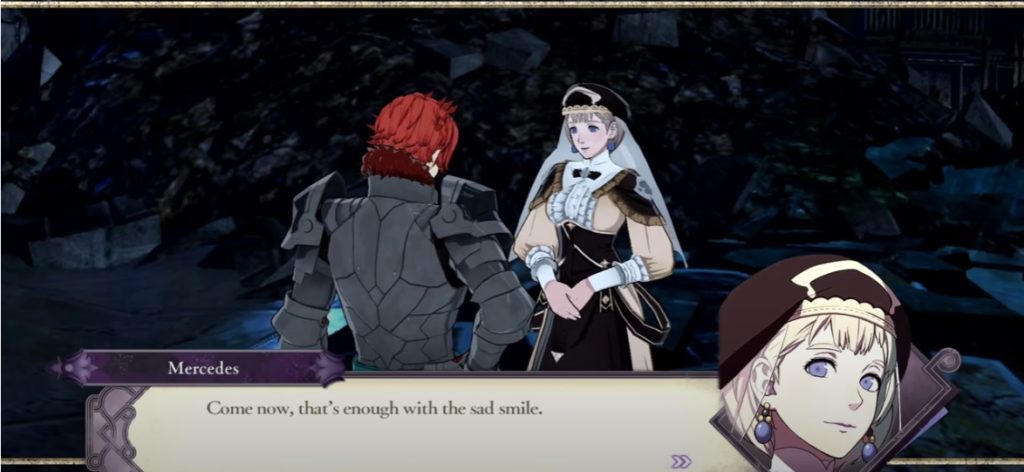
Recollection and Regret
This last track is perhaps the greatest example of harmony in this chain. This is because the very emotional track “Recollection and Regret”, only starts playing after their initial banter. Thus the first few seconds of the scene are left entirely without music, thereby completely avoiding any clashes.
The piece has a bpm of 80 and consists mainly of quarter and half notes. The measures in the bass clef repeat with slight variations, but always moving in an upwards arc within the measure, before starting lower again at the beginning of the next.21 This creates a sense of lingering in the gap between the high and low, almost like longing and ties perfectly into the title of the piece.
And, because the scene carries the same sense of recollecting lingering feelings it matches the tone and message of the scene: after lingering, moving forwards.
Notably, this same track is used in most A supports, most of which are similarly emotional. For many members of our second class of players, the repeating ones, this creates a strong association between the track and the emotions displayed in previous A supports the player has experienced.
Act Two Finale
Thus, we can conclude that, overall, the music in this support chain adeptly follows the story and character arcs. As we watch the calm exterior of the Casanova peel away revealing a bleeding heart, new scabs cover the old wound and the music accurately conveys to the player that the character's arc has progressed. Now his story has ended and like the Caregiver Mercedes, his past is past and rests in the land of Recollection.
The General Conclusion of the Analysis
To conclude, there are some moments when the music fits and some moments when it does not. Whether the music fits or not, however, is not clear cut. It depends heavily on the situation the player is in at the time of watching the support conversations. If the player is aware of Bernadetta’s tragic story, the music in her C support with Ferdinand falls flat, but if the player does not yet know the character that well, the music can work to amplify the comical effect of the situation. However, the inverse can also be true. In Sylvain’s and Mercedes’ C support a song that is initially fitting becomes less so when Sylvain becomes sour and starts to show his anger. The calm music in the background that was first adding to the narrative now detracts from the story beat it is trying to accompany.
Though, it is important to note that these ‘incongruences’ are also an unfortunate side effect from the fact that there are a limited amount of ‘support songs’ in the game. There are only 7 support songs that try to cover most of the emotional spectrum, but they are not always successful in portraying the emotion that certain situations ask. In those moments where the music doesn’t work, the story's tone can feel strange or disjointed. But when the music suits the context, it elevates the narrative experience, fulfilling its purpose.
Of Snakes and Circuit Boards
For our quantitative research, we scraped YouTube comments from songs used in-game, to then do a sentiment analysis on said comments. Afterwards we also wanted to use the GEMS database on the same songs and then compare the two results to see if they were similar in some way shape or form.
Our Method
We decided to scrape YouTube comments to get our data on people’s opinions, because YouTube is the largest platform where Fire Emblem music is discussed. There are game forums and Fire Emblem specific forums that discuss Fire Emblem: Three houses, but specific conversations on music are sporadic at best and usually don’t have a large enough sample size to make scraping worthwhile, whereas a YouTube video of songs from the game can have hundreds of comments about what the song made them feel, which is what we want to study. So, we made a scraper using Python and employed Chat GPT whenever help was necessary
To write our web scraper we used the scrapy30 framework, a free and open-source web crawling framework. We also requested the YouTube data API v311, this API provides access to YouTube data and videos. By using the YouTube API we could scrape comments at will without risking our IP getting blocked and enjoy a more streamlined process when extracting the data into a JSON format, to then convert to a CSV file. This also helped our future data-cleaning. When running the script in the command-line two arguments are passed, the YouTube video ID, the 11 character alphanumeric string right after “v=”in the video URL, and the YouTube API key followed by the “O-” flag with a filename to write our results to. By changing the arguments that we passed for every video, the same script could extract data from the 6 different videos.
The scraper:
import scrapy
import json

class YoutubeApiCommentsSpider(scrapy.Spider):
    # `scrapy crawl` naam om spider te activaten
    name = "youtube_api_comments"

    def __init__(self, video_id=None, api_key=None, *args, **kwargs):
        """
        geef command line arguments voor de video id (stuk in de url achter 'v=') en de api key ( vraag aan senne )
        """
        super().__init__(*args, **kwargs)
        self.video_id = video_id
        self.api_key = api_key
    def start_requests(self):
        """
        https://developers.google.com/youtube/v3/docs
        eerste methode bouwt youtube data api url en haalt eerste 100 comments op
        """
        url = (
            f"https://www.googleapis.com/youtube/v3/commentThreads?"
            f"part=snippet&videoId={self.video_id}&maxResults=100&key={self.api_key}"
        )
        # stuur request 1 naar api
        yield scrapy.Request(url=url, callback=self.parse)
    def parse(self, response):
        """
        verwerkt json response en extract naar python libraries
        """
        # Parse JSON
        data = json.loads(response.body)

        # Loop door comment
        for item in data.get("items", []):
            snippet = item["snippet"]
            comment_data = snippet["topLevelComment"]["snippet"]
            # data yield (dictionary format)
            yield {
                "author": comment_data["authorDisplayName"], # Username
                "comment": comment_data["textDisplay"], # The comment content
                "like_count": comment_data.get("likeCount", 0), # Likes
                "reply_count": snippet.get("totalReplyCount", 0), # Number of replies
                "published_at": comment_data["publishedAt"], # Timestamp
            }

        # nextpagetoken check
        next_page_token = data.get("nextPageToken")
        if next_page_token:
            # next page of results
            next_url = (
                f"https://www.googleapis.com/youtube/v3/commentThreads?"
                f"part=snippet&videoId={self.video_id}&maxResults=100"
                f"&pageToken={next_page_token}&key={self.api_key}"
            )
            # Request the next page of comments
            yield scrapy.Request(url=next_url, callback=self.parse)
After acquiring the data, we used OpenRefine to structure and clean the data in the way we wanted to. Luckily, the way YouTube is structured allowed for a very seamless cleaning process, because each file required the same processes.
GREL’s used:
value.replace("<br>","\n")
value.replace(/<a[^>]*>(.*?)<\/a>/, "$1")
value.replace("'","'")
value.replace(""","\"")
value.replace("<","<")
value.replace(/<b>(.*?)<\/b>/, "**$1**")
Afterwards, we made another Python script to conduct a sentiment analysis on the cleaned CSV’s and visualized them using TableauPublic.
In this script we made use of Python’s argparse, pandas25 , NumPy24, and Hugging Face14’s transformers (pipeline & AutoTokenizer) for command-line arguments in order to make the script run seamlessly from the command-line and give it an in- and output file. Pandas is a Python library used for working with data sets. It helps to explore, analyze, clean and manipulate data. NumPy is a Python library used for working with arrays, and is a core dependency for pandas because its core data structures, like DataFrames, are built on top of NumPy arrays. A DataFrame is a 2 dimensional data structure, for example: a 2 dimensional array, or a table with columns and rows.
We also used the NumPy library to change the scale of our data by applying a logarithm: numpy.log1p(x) where x is the amount of likes15, because this sort of data can be very spread out (ex. 1-20000 likes or more). This logarithmic transform helps normalize the skewed distribution of likes, compresses large values, reduces impact of outliers, and makes trends easier to spot.
To do the sentiment analysis we used Hugging Face14’s transformers library which provides an array of NLP (Natural Language Processing) AI models. These are pre-trained models that are capable of basic language processing. In this study, we used the pretrained “nateraw/bert-base-uncased-emotion” model.
This NLP model would take our comments as an input and then generate/assign 1 out of 6 emotions to that comment in a new column (fig. 8). Then each comment would get a weight-value based on their like and reply count calculated with our log function.

The sentiment analysis:
import argparse
import pandas as pandas
import numpy as numpy
from transformers import pipeline
from transformers import AutoTokenizer#tokenizer voor comments over 512
#command: python sentiment_analysis.py input.csv output.csv
#parse command-line arguments
parser = argparse.ArgumentParser(description="sentiment analysis youtube comments")
parser.add_argument("input_csv", help="Path to input CSV file")
parser.add_argument("output_csv", help="Path to output CSV file")

#Define args !!!
args = parser.parse_args()

#load CSV
df = pandas.read_csv(args.input_csv)

# validate the columns (check if the csv file contains the correct columns)
#https://stackoverflow.com/questions/49234647/check-that-a-csv-file-has-the-correct-column-names-python
required_columns = {'author','comment','like_count','reply_count','published_at'}
assert required_columns.issubset(df.columns), "missing columns in CSV"

#https://huggingface.co/nateraw/bert-base-uncased-emotion
emotion_classifier = pipeline("text-classification", model="nateraw/bert-base-uncased-emotion",top_k=1)

# downgrade to numpy needed!!! 1.24.4
#tokenizer used with max_tokens to safely truncate messages that are over 512 Tokens
tokenizer = AutoTokenizer.from_pretrained("nateraw/bert-base-uncased-emotion")

MAX_TOKENS = 512

def detect_sentiment(text):
    try:
        """
        old version(crash by long comments >512 tokens):
        results = emotion_classifier(str(text))[0]
        print(f"Results for comment: {results}")
        """
        encoded =       tokenizer(str(text),truncation=True,max_length=MAX_TOKENS,return_tensors="pt")
        decoded_text = tokenizer.decode(encoded['input_ids'][0],  skip_special_tokens=True)
        result = emotion_classifier(decoded_text)[0]
        return result[0]['label']

    except Exception as e:# don't forget to add Exception as e
        print(f"Error processing comment: {str(text)[:80]}\nError: {e}")
        return  'unknown'
print("processing...")
#apply the above function to the comment column and save to new emotion column
df['emotion'] = df['comment'].apply(detect_sentiment)

#apply weight based on the amount of likes and replies using log functions(keep proportions meaningfull)
df['like_weight'] = df['like_count'].apply(lambda x: round(numpy.log1p(x), 2))#scale with log
df['reply_weight'] = df['reply_count'].apply(lambda x: round(numpy.log1p(x), 2))#scale with log
df['total_weight'] = round(1 + df['like_weight'] + 0.5 * df['reply_weight'], 2)

#export to new CSV
df.to_csv(args.output_csv, index = False)
#use prefix f to interpolate the variable in your string
print(f"done, Exported to {args.output_csv}")
When the sentiment analysis was applied to all the files, we combined them all together and created a new column based on the video ids using pandas. This file was then uploaded to TableauPublic31 to visualize our data.
The combination script:
import pandas as pandas
import os

folder_path = os.getcwd()

#empty list to store all csvs
combined_dfs = []

# loop through all files to add the song name into the
for filename in os.listdir(folder_path):
    if filename.endswith(".csv"):
        file_path = os.path.join(folder_path,filename)
        df = pandas.read_csv(file_path)
        song_name = filename.replace("-sentiment.csv","").replace("-"," ")
        df["video_id"] = song_name
        combined_dfs.append(df)

#combine all dataframes
final_df = pandas.concat(combined_dfs, ignore_index=True)

#save to new CSV
final_df.to_csv("combined_songs.csv", index=False)
print("Combined file saved as 'combined_songs.csv'")
However, due to time constraints and other problems, we weren’t able to work with GEMS to further conduct our research. So our results are less conclusive than we would have liked.
Our Results
Should the imbed fail, this link leads to the detailed graphs on TableauPublic31's website:
From this data we conclude that the feeling of joy is the most prevalent in the comments from all 6 songs. This is not very surprising, because when people comment on YouTube it is usually something exceedingly positive or very negative. Perhaps that is also why the sentiment of anger is the second most common.
Unfortunately, the data we pulled from the YouTube comments is only part of the research, but due to lack of access to GEMS, it was impossible to conduct the second part of our research. Therefore, a conclusion is difficult to reach, because our idea was not able to reach its full potential.
Technical Difficulties
GEMS
Because GEMS is proprietary20, it cannot be used without permission and one cannot gain access to the system in order to analyze the songs. In theory, GEMS measures the evoked emotions of the selected piece of music and puts them on a scale. We can’t be sure of how this exactly functions, however, because information on the GEMS system is incredibly scarce. Even papers that mention GEMS or used GEMS, do not specify how it works. This is understandable with it being a proprietary model, but it remains unfortunate that basic information around the general functionality is so limited. Therefore, we contacted the maker of GEMS and requested access, but seeing as there was no response, we cannot use or give more information on how GEMS could be an asset or detriment in research around this topic.
YouTube and Nintendo
While YouTube has videos with a lot of user interaction we can use, it is sadly not an ideal platform. Nintendo is very strict with their copyright usage and does not officially make their music available for free23. However, people often choose to ignore that directive, and post their songs anyway. This results in frequent so-called "ban-waves" from Nintendo. Which means that a lot of songs are regularly taken down, causing the comments to disappear. This makes scraping for data relatively limiting, because the songs that still have a lot of comments are few. We did manage to find some videos, but there is a large divide between the view-, comment- and like-count of some songs in comparison to others.
The Comments
Beyond proprietary matters, we also encountered some issues with the material itself, as a lot of comments were simply quotes from the game or even from other videos that used the songs as background music. These may have skewed the sentiment analysis somewhat. On the other hand, one can argue that the player's choice of quote accurately reflects what emotion they were experiencing when they recalled the quote and thus the analysis remains mostly intact. Another issue lies in the sheer number of inside-jokes circulating the fandom which may have further confused the sentiment analysis AI.
Literature Study and Bibliography
Read Literature
Abia, Arthur, and Loïc Caroux. ‘Effects of Self-Selected Music and the Arousal Level of Music on User Experience and Performance in Video Games’. In Proceedings of the 20th Congress of the International Ergonomics Association (IEA 2018), 3–12. Springer, Cham, 2019. https://doi.org/10.1007/978-3-319-96059-3_1.
Aljanaki, Anna, Dimitrios Bountouridis, John Ashley Burgoyne, Jan Van Balen, Frans Wiering, Henkjan Honing, and Remco Veltkamp. ‘Designing Games with a Purpose for Data Collection in Music Research. Emotify and Hooked: Two Case Studies’. In Games and Learning Alliance, edited by Alessandro De Gloria, 8605:29–40. Lecture Notes in Computer Science. Cham: Springer International Publishing, 2014. https://doi.org/10.1007/978-3-319-12157-4_3.
Atkinson, Sean E. ‘Soaring Through the Sky: Topics and Tropes in Video Game Music’. Music Theory Online 25, no. 2 (1 July 2019). https://mtosmt.org/issues/mto.19.25.2/mto.19.25.2.atkinson.html.
Collins, K. C. Playing with Sound: A Theory of Interacting with Sound and Music in Video Games. The MIT Press, 2013. https://doi.org/10.7551/mitpress/9442.001.0001.
Green, Melanie C., Fitzgerald ,Kaitlin, and Melissa M. and Moore. ‘Archetypes and Narrative Processes’. Psychological Inquiry 30, no. 2 (3 April 2019): 99–102. https://doi.org/10.1080/1047840X.2019.1614808.
Hart, Iain. ‘Meaningful Play: Performativity, Interactivity and Semiotics in Video Game Music’. Musicology Australia 36, no. 2 (3 July 2014): 273–90. https://doi.org/10.1080/08145857.2014.958272.
Ivănescu, Andra. Popular Music in the Nostalgia Video Game: The Way It Never Sounded. 1st ed. 2019. Palgrave Studies in Audio-Visual Culture. Cham: Springer International Publishing, 2019. https://doi.org/10.1007/978-3-030-04281-3.
Kamp, Michiel, Tim Summers, and Mark Sweeney. Ludomusicology: Approaches to Video Game Music. Genre, Music and Sound. Sheffield, UK: Equinox Publishing, 2016.
Klimmt, Christoph, Daniel Possler, Nicolas May, Hendrik Auge, Louisa Wanjek, and Anna-Lena Wolf. ‘Effects of Soundtrack Music on the Video Game Experience’. Media Psychology 22, no. 5 (3 September 2019): 689–713. https://doi.org/10.1080/15213269.2018.1507827.
Lim, Hayoung A., and Heekyeong Park. ‘The Effect of Music on Arousal, Enjoyment, and Cognitive Performance’. Psychology of Music 47, no. 4 (1 July 2019): 539–50. https://doi.org/10.1177/0305735618766707.
Lowe, Roy. ‘The Educational Impact of the Eugenics Movement’. International Journal of Educational Research 27, no. 8 (27 February 1998): 647–60. https://doi.org/10.1016/S0883-0355(98)00003-2.
Medina-Gray, Elizabeth. ‘Analyzing Modular Smoothness in Video Game Music’. Music Theory Online 25, no. 3 (1 October 2019). https://www.mtosmt.org/issues/mto.19.25.3/mto.19.25.3.medina.gray.html.
Summers, Tim. Understanding Video Game Music. Cambridge: Cambridge University Press, 2016. https://doi.org/10.1017/CBO9781316337851.
Vaughn Becker, David, and Steven L. Neuberg. ‘Archetypes Reconsidered as Emergent Outcomes of Cognitive Complexity and Evolved Motivational Systems’. Psychological Inquiry 30, no. 2 (2019): 59–75. https://doi.org/10.1080/1047840X.2019.1614795.
Referenced Works
Acuff, Dan. ‘The Power of Character Archetypes’. Young Consumers 11, no. 4 (1 January 2010). https://doi.org/10.1108/yc.2010.32111daa.002.
Aljanaki, Anna, Frans Wiering, and Remco C. Veltkamp. ‘Studying Emotion Induced by Music through a Crowdsourcing Game’. Information Processing & Management 52, no. 1 (January 2016): 115–28. https://doi.org/10.1016/j.ipm.2015.03.004.
Anatone, Richard. ‘Leitmotivic Strategies in Nobuo Uematsu’s Final Fantasy Soundtracks’. Music Theory Spectrum 45, no. 2 (2023): 257–83. https://doi.org/10.1093/mts/mtad009.
Calm Winds Over Gentle Waters (Woodwind Quartet // Piano Solo) - Fire Emblem: Three Houses, 2024. https://www.youtube.com/watch?v=8G6T4MRUDeo.
Fire Emblem Wiki. ‘Bernadetta’. Accessed 10 April 2025. https://fireemblemwiki.org/wiki/Bernadetta.
Fire Emblem Wiki. ‘Ferdinand’. Accessed 10 April 2025. https://fireemblemwiki.org/wiki/Ferdinand.
Fire Emblem Wiki. ‘Ferdinand/Supports’, 16 May 2025. https://fireemblem.fandom.com/wiki/Ferdinand/Supports.
Fire Emblem Wiki. ‘List of Music in Fire Emblem: Three Houses’, 1 May 2025. https://fireemblem.fandom.com/wiki/List_of_Music_in_Fire_Emblem:_Three_Houses.
Fire Emblem Wiki. ‘Sylvain’. Accessed 10 April 2025. https://fireemblemwiki.org/wiki/Sylvain.
Fire Emblem Wiki. ‘Sylvain/Supports’, 10 May 2025. https://fireemblem.fandom.com/wiki/Sylvain/Supports.
Google for Developers. ‘API Reference | YouTube Data API’. Accessed 17 May 2025. https://developers.google.com/youtube/v3/docs.
Harding, Christopher. ‘Hikikomori’. The Lancet Psychiatry 5, no. 1 (1 January 2018): 28–29. https://doi.org/10.1016/S2215-0366(17)30491-1.
‘Het Brand Archetype Caregiver. Dienaar, Zorger, Moeder.’, 22 April 2020. https://www.sterkmerk.online/archetype-caregiver-brand/.
‘Hugging Face – The AI Community Building the Future.’, 16 May 2025. https://huggingface.co/.
Jack. ‘Answer to “Purpose of numpy.Log1p( )?”’ Stack Overflow, 20 May 2019. https://stackoverflow.com/a/56213786.
Jacobsen, Peer-Ole, Hannah Strauss, Julia Vigl, Eva Zangerle, and Marcel Zentner. ‘Assessing Aesthetic Music-Evoked Emotions in a Minute or Less: A Comparison of the GEMS-45 and the GEMS-9’. Musicae Scientiae 29, no. 1 (1 March 2025): 184–92. https://doi.org/10.1177/10298649241256252.
Kato, Takahiro A., Shigenobu Kanba, and Alan R. Teo. ‘Hikikomori : Multidimensional Understanding, Assessment, and Future International Perspectives’. Psychiatry and Clinical Neurosciences 73, no. 8 (2019): 427–40. https://doi.org/10.1111/pcn.12895.
‘Mercedes - Fire Emblem Wiki’. Accessed 10 April 2025. https://fireemblemwiki.org/wiki/Mercedes.
Moon, JaeYoung, EunHye Cho, Yeabon Jo, KyungJoong Kim, and Eunsung Song. ‘Investigating the Effect of Emotional Matching between Game and Background Music on Game Experience in a Valence–Arousal Space’. IEEE Transactions on Games, 2024, 1–20. https://doi.org/10.1109/TG.2024.3424459.
Musemap. ‘GEMS’. Accessed 17 May 2025. https://musemap.org/resources/gems.
Musescore. ‘Fire Emblem Three Houses - Recollection and Regret’. Musescore.com. Accessed 15 May 2025. https://musescore.com/user/27428792/scores/5671032.
Neill, Conor. ‘Understanding Personality: The 12 Jungian Archetypes - Moving People to Action’, 21 April 2018. https://conorneill.com/2018/04/21/understanding-personality-the-12-jungian-archetypes/.
‘Nintendo Intellectual Property’. Accessed 17 May 2025. https://www.nintendo.com/au/legal/nintendo-intellectual-property/?srsltid=AfmBOopK0OVIj6bzx12AWTICtVvUQ8IjM3qJklwESEo4Y4h01OsEDd25.
‘NumPy Documentation — NumPy v2.2 Manual’. Accessed 17 May 2025. https://numpy.org/doc/stable/.
‘Package Overview — Pandas 2.2.3 Documentation’. Accessed 17 May 2025. https://pandas.pydata.org/docs/getting_started/overview.html.
Pearson, Carol S. ‘Individuation and Archetypes’. In Political and Civic Leadership, 2:640–46. United States: SAGE Publications, Incorporated, 2010. https://doi.org/10.4135/9781412979337.n71.
Râmbu, Nicolae. ‘The Philosophy of Casanova’. Philosophy and Literature 36, no. 2 (2012): 271–84.
Ramaswamy, Shobha. ‘Archetypes in Fantasy Fiction: A Study of J. R. R. Tolkien and J. K. Rowling’. Language in India 14, no. 1 (2014): 402-.
Roberts, Joshua, Jason Wuertz, Max V. Birk, Scott Bateman, and Daniel J. Rea. ‘How the Emotional Content of Music Affects Player Behaviour and Experience in Video Games’. In 2024 IEEE Gaming, Entertainment, and Media Conference (GEM), 1–6, 2024. https://doi.org/10.1109/GEM61861.2024.10585638.
‘Scrapy 2.13 Documentation — Scrapy 2.13.0 Documentation’. Accessed 17 May 2025. https://docs.scrapy.org/en/latest/.
Tableau Public. ‘Discover’. Accessed 17 May 2025. https://public.tableau.com/app/discover.
‘The Caregiver Archetype - Everything You Need to Know’. Accessed 13 May 2025. https://www.dabblewriter.com/articles/the-caregiver-archetype-everything-you-need-to-know.
TV Tropes. ‘The Casanova’. Accessed 28 April 2025. https://tvtropes.org/pmwiki/pmwiki.php/Main/TheCasanova.
Web Design, UI/UX, Branding, and App Development Blog. ‘Caregiver Brand Archetype: Caring and Self-Sacrificing | Ramotion Agency’, 19 November 2024. https://www.ramotion.com/blog/caregiver-archetype/.
Yang, Zengyao, Qiruo Su, Jieren Xie, Hechong Su, Tianrun Huang, Chengcheng Han, Sicong Zhang, Kai Zhang, and Guanghua Xu. ‘Music Tempo Modulates Emotional States as Revealed through EEG Insights’. Scientific Reports 15, no. 1 (10 March 2025): 8276. https://doi.org/10.1038/s41598-025-92679-1.
Footnotes
-
Acuff, Dan. ‘The Power of Character Archetypes’. Young Consumers 11, no. 4 (1 January 2010). https://doi.org/10.1108/yc.2010.32111daa.002. ↩
-
Aljanaki, Anna, Frans Wiering, and Remco C. Veltkamp. ‘Studying Emotion Induced by Music through a Crowdsourcing Game’. Information Processing & Management 52, no. 1 (January 2016): 115–28. https://doi.org/10.1016/j.ipm.2015.03.004. ↩
-
Anatone, Richard. ‘Leitmotivic Strategies in Nobuo Uematsu’s Final Fantasy Soundtracks’. Music Theory Spectrum 45, no. 2 (2023): 257–83. https://doi.org/10.1093/mts/mtad009. ↩
-
Calm Winds Over Gentle Waters (Woodwind Quartet // Piano Solo) - Fire Emblem: Three Houses, 2024. https://www.youtube.com/watch?v=8G6T4MRUDeo. ↩
-
Fire Emblem Wiki. ‘Bernadetta’. Accessed 10 April 2025. https://fireemblemwiki.org/wiki/Bernadetta. ↩
-
Fire Emblem Wiki. ‘Ferdinand’. Accessed 10 April 2025. https://fireemblemwiki.org/wiki/Ferdinand. ↩
-
Fire Emblem Wiki. ‘Ferdinand/Supports’, 16 May 2025. https://fireemblem.fandom.com/wiki/Ferdinand/Supports. ↩↩↩
-
Fire Emblem Wiki. ‘List of Music in Fire Emblem: Three Houses’, 1 May 2025. https://fireemblem.fandom.com/wiki/List_of_Music_in_Fire_Emblem:_Three_Houses. ↩
-
Fire Emblem Wiki. ‘Sylvain’. Accessed 10 April 2025. https://fireemblemwiki.org/wiki/Sylvain. ↩
-
Fire Emblem Wiki. ‘Sylvain/Supports’, 10 May 2025. https://fireemblem.fandom.com/wiki/Sylvain/Supports. ↩↩↩
-
Google for Developers. ‘API Reference | YouTube Data API’. Accessed 17 May 2025. https://developers.google.com/youtube/v3/docs. ↩
-
Harding, Christopher. ‘Hikikomori’. The Lancet Psychiatry 5, no. 1 (1 January 2018): 28–29. https://doi.org/10.1016/S2215-0366(17)30491-1. ↩↩↩
-
‘Het Brand Archetype Caregiver. Dienaar, Zorger, Moeder.’, 22 April 2020. https://www.sterkmerk.online/archetype-caregiver-brand/. ↩
-
‘Hugging Face – The AI Community Building the Future.’, 16 May 2025. https://huggingface.co/. ↩↩
-
Jack. ‘Answer to “Purpose of
numpy.Log1p( )?”’ Stack Overflow, 20 May 2019. https://stackoverflow.com/a/56213786. ↩ -
Jacobsen, Peer-Ole, Hannah Strauss, Julia Vigl, Eva Zangerle, and Marcel Zentner. ‘Assessing Aesthetic Music-Evoked Emotions in a Minute or Less: A Comparison of the GEMS-45 and the GEMS-9’. Musicae Scientiae 29, no. 1 (1 March 2025): 184–92. https://doi.org/10.1177/10298649241256252. ↩
-
Kato, Takahiro A., Shigenobu Kanba, and Alan R. Teo. ‘Hikikomori : Multidimensional Understanding, Assessment, and Future International Perspectives’. Psychiatry and Clinical Neurosciences 73, no. 8 (2019): 427–40. https://doi.org/10.1111/pcn.12895. ↩
-
‘Mercedes - Fire Emblem Wiki’. Accessed 10 April 2025. https://fireemblemwiki.org/wiki/Mercedes. ↩
-
Moon, JaeYoung, EunHye Cho, Yeabon Jo, KyungJoong Kim, and Eunsung Song. ‘Investigating the Effect of Emotional Matching between Game and Background Music on Game Experience in a Valence–Arousal Space’. IEEE Transactions on Games, 2024, 1–20. https://doi.org/10.1109/TG.2024.3424459. ↩
-
Musemap. ‘GEMS’. Accessed 17 May 2025. https://musemap.org/resources/gems. ↩
-
Musescore. ‘Fire Emblem Three Houses - Recollection and Regret’. Musescore.com. Accessed 15 May 2025. https://musescore.com/user/27428792/scores/5671032. ↩
-
Neill, Conor. ‘Understanding Personality: The 12 Jungian Archetypes - Moving People to Action’, 21 April 2018. https://conorneill.com/2018/04/21/understanding-personality-the-12-jungian-archetypes/. ↩↩
-
‘Nintendo Intellectual Property’. Accessed 17 May 2025. https://www.nintendo.com/au/legal/nintendo-intellectual-property/?srsltid=AfmBOopK0OVIj6bzx12AWTICtVvUQ8IjM3qJklwESEo4Y4h01OsEDd25. ↩
-
‘NumPy Documentation — NumPy v2.2 Manual’. Accessed 17 May 2025. https://numpy.org/doc/stable/. ↩
-
‘Package Overview — Pandas 2.2.3 Documentation’. Accessed 17 May 2025. https://pandas.pydata.org/docs/getting_started/overview.html. ↩
-
Pearson, Carol S. ‘Individuation and Archetypes’. In Political and Civic Leadership, 2:640–46. United States: SAGE Publications, Incorporated, 2010. https://doi.org/10.4135/9781412979337.n71. ↩
-
Râmbu, Nicolae. ‘The Philosophy of Casanova’. Philosophy and Literature 36, no. 2 (2012): 271–84. ↩
-
Ramaswamy, Shobha. ‘Archetypes in Fantasy Fiction: A Study of J. R. R. Tolkien and J. K. Rowling’. Language in India 14, no. 1 (2014): 402-. ↩↩
-
Roberts, Joshua, Jason Wuertz, Max V. Birk, Scott Bateman, and Daniel J. Rea. ‘How the Emotional Content of Music Affects Player Behaviour and Experience in Video Games’. In 2024 IEEE Gaming, Entertainment, and Media Conference (GEM), 1–6, 2024. https://doi.org/10.1109/GEM61861.2024.10585638. ↩
-
‘Scrapy 2.13 Documentation — Scrapy 2.13.0 Documentation’. Accessed 17 May 2025. https://docs.scrapy.org/en/latest/. ↩
-
Tableau Public. ‘Discover’. Accessed 17 May 2025. https://public.tableau.com/app/discover. ↩↩
-
‘The Caregiver Archetype - Everything You Need to Know’. Accessed 13 May 2025. https://www.dabblewriter.com/articles/the-caregiver-archetype-everything-you-need-to-know. ↩
-
TV Tropes. ‘The Casanova’. Accessed 28 April 2025. https://tvtropes.org/pmwiki/pmwiki.php/Main/TheCasanova. ↩
-
Web Design, UI/UX, Branding, and App Development Blog. ‘Caregiver Brand Archetype: Caring and Self-Sacrificing | Ramotion Agency’, 19 November 2024. https://www.ramotion.com/blog/caregiver-archetype/. ↩
-
Yang, Zengyao, Qiruo Su, Jieren Xie, Hechong Su, Tianrun Huang, Chengcheng Han, Sicong Zhang, Kai Zhang, and Guanghua Xu. ‘Music Tempo Modulates Emotional States as Revealed through EEG Insights’. Scientific Reports 15, no. 1 (10 March 2025): 8276. https://doi.org/10.1038/s41598-025-92679-1. ↩
-
This flirtation only occurs if the player chooses the female-presenting appearance. ↩