ANIME
A beginner's guide to fanservice
Fanservice in anime can be defined in a lot of different ways. If we look at it from a general perspective, it can refer to any input in the show meant to please the audience and usually has zero to little narrative significance, such as cameos. Nowadays however, when people use the term fanservice, it usually refers to the sexual aspect, which will be the focus of this research. In this case, you could define it as “Showing a series’ characters in risque or compromising positions to give the fans a thrill.” 1
Fanservice is often associated with female characters in anime, but male fanservice does exist as well and it is featured more and more. There is however, a difference between the fanservice of female and male characters. According to Wittenfelt, the female character “exude[s] sexuality whenever she is seen. Dressed in skin-tight clothes she is practically naked; always skinny, and usually ha[s] un-proportionally large breasts and buttocks.” Whereas the male character “is far milder in comparison, […] ” and “is rarely portrayed with the same kind of submission. The mere act invalidates his gender performance [...]”.2 So because the ideals of both genders are different, so is the fanservice, trying to depict the ideal man or woman. In this research we will discuss both female and male fanservice.
When people talk about fanservice in anime, the genre “ecchi” often comes up in the conversation. Ecchi is a genre most commonly used to refer to soft-core pornographic or sexually suggestive anime and manga. The term is derived from the Japanese pronunciation of the letter H, taken from the first letter of the word “hentai”, meaning “weird” or “perverted” in Japanese.3 There is discussion whether the term fanservice can be linked with this genre, because some people argue that fanservice has received the connotation of disliking the sexual scenes, whereas ecchi is a genre where you can expect those sexually charged shots.4 However, the most common take is that ecchi anime is anime with an overabundance of fanservice.2 For our research, we will take on the latter argument.
Although fanservice is often sexual, little to zero scenes are very explicit or graphic. Explicit nudity and sexual intercourse falls more in the area of the genre called hentai. The western world uses the term “hentai” to describe sexually explicit anime, manga and other Japanese media of similar nature.5 However, there are some ecchi anime that do include explicit nudity, but in this case, usually an additional non-censored version is made so it can still be aired on TV. Fanservice often uses hints of sexuality to attract and please the viewers. Ecchi, and fanservice, are so to say a game of teasing, showing what could happen rather than fulfilling the desire. So while hentai’s goal of the narrative is the sexually explicit intercourse, ecchi utilises plot and sexually explicit scenes in equal measures.2
Characters that are made for pleasure
Anime often include characters that are made for fanservice. It is not always their sole purpose in the story, but it is obvious from their design or behaviour that it is one of the character’s objectives. These characters can be separated into two categories: The first are characters that are made to give fanservice to the viewers, and the second are characters that allow you, through their eyes, to view the fanservice. The former are the ones that are more likely to end up in a fanservice situation. The latter are the ones that, within the plot, often gaze on the same objects that the viewers glimpse. This makes fanservice as much a part of the experience of the characters in anime as it is part of the audience experience.6
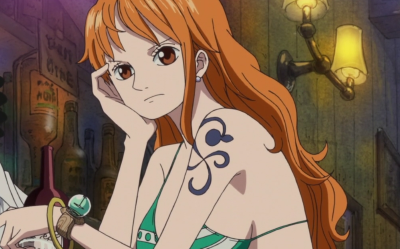
A good example of a character from the first category is Nami from “One Piece”. This is an anime about pirates who are looking for the world’s greatest treasure called “the One Piece”. Nami is the navigator of the Straw Hat pirates, the pirate group of the main character Monkey D. Luffy. Even though she is a part of the main cast and an important crewmember who helps them navigate the wild seas of the Grand Line, many fans see her as a character meant for fanservice. This is because she is often seen wearing a bikini, or a revealing outfit, which highlights her breasts that are frequently zoomed in on. Moreover, as she used to be a thief and is skilled at deceiving people, she often tries to trick men with her charm to get what she wants. That’s why her personality and behaviour also add to her being a character meant for fanservice.
For the second category, a good example would be Gou, a female supporting character from the anime “Free!”. The story is about a swimming club, high school rivalry and friendship. Although not the main character, Gou still plays an important role in the story. She becomes the manager of her brother's former all-male swim team and supports them fully. Since she has an unusual obsession with muscles, she is often flustered when she sees them in swimming attire. Although she doesn’t have a romantic relationship with any of the male characters, she frequently stares with twinkling eyes at their muscles. The boys of the swimming team are all athletically built and are more often than not seen shirtless, while she herself is most of the time dressed in a normal school uniform. Gou is seen as a receiver in the anime, which means she is a character that allows you to experience the fanservice through her eyes. Free! can therefore be seen as a kind of breakthrough anime in the mainly male gaze dominated industry, since it is one of the first mainstream anime that includes fanservice directed toward a female audience. 2

Fanservice in different fonts
In this research, we focus on the sexual aspect of fanservice, but there are many forms in which this aspect of fanservice can be expressed.
The character
If we just think about the character itself, fanservice can appear through the means of their clothing or specific body parts. Clothing that allows the characters to expose more skin, such as swimsuits, costumes or even ripped clothing, is often used in these fanservice situations. To exaggerate this, specific camera-angles show certain body parts more frequently, such as breasts, legs and thighs or abdominal muscles. On top of the frequency of these shots, the bodies of these characters are more often than not idealised and an exaggeration of reality. The female characters are for example abnormally big-busted with an hour-glass body, while the male characters are overly muscular and athletic. A famous low-angle shot that is often used in anime is known as the panchira (パンチら) or pantyshot. As the name suggests, it is a shot where you can catch a glimpse of a girl’s panties under her skirt. This is likely the result of someone spying under her skirt or it was revealed “on accident”, due to a gust of wind for example. Reactions on these types of situations, like blushing or a character, through which we see the fanservice, having a nose bleed can indicate fanservice as well.4
Scenes and episodes
There are also entire scenes or whole episodes that are made for the sole purpose of fanservice. These scenes can for example depict someone who is bathing or a character who is changing clothes. During such scenes the viewer can see the character fully naked, with exception for certain body parts that are covered by, for example, the water or soap bubbles. These situations don’t add much to the story but are given as an extra for the viewer. There are specific episodes that create more opportunities for fanservice as well. The famous beach or pool episode, where most of the main characters go to the beach/pool together, is a well-known fanservice trope. It allows the viewer to see the characters in swimwear for the whole episode, creating numerous fanservice opportunities.4
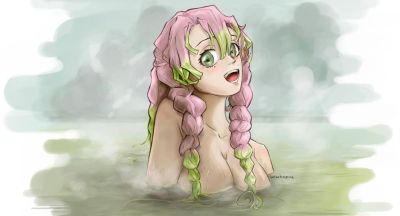
A great example of an entire fanservice scene can be found in season 3, episode 1 of the anime Demon Slayer. This episode shows a scene with the Love Hashira Mitsuri, male protagonist Tanjiro Kamado and supporting character Genya Shinazugawa, who are sitting in an onsen (japanese term for hotspring). In this shot, you can see Tanjiro and Genya both shirtless while their naked lower body is not visible because of the water. Both of these male characters are physically quite built and show a lot of muscle to grab the attention of the female viewers. But this isn’t as strongly expressed as fanservice like it is in the case of Mitsuri. She is seen fully naked with just her hair covering her upper parts and the water also covering her upper body. Even when she steps out of the onsen at the end of the scene, her behind is also barely covered by her hair which seems more attention grabbing than the other two characters. This is why this particular scene can be seen as fanservice to both female as male viewers. 7
The design
Sometimes fanservice is not limited to a character’s appearance or to a single suggestive scene or episode. Instead, fanservice can be embedded into the very design of an anime’s world, rules, or social structure. In these cases, the setting itself is intentionally created in a way that continuously enables or encourages fanservice situations throughout the series.4
The house pet system of the ecchi anime Kakegurui illustrates this concept very well. The story of this anime takes place in the high-class elite school named Hyakkaou Private Academy, a school where students are evaluated on their gambling skills. As such, a hierarchy at the school is developed, with the talented gamblers at the top and the indebted students at the bottom. Students who are in debt and can’t pay their monetary contribution to the student council, become housepets. As a result, the girls get the title of mike (ミケ) or kitty, and the boys pochi (ポチ) or doggy. Once you become a housepet, you are obliged to do everything a non-housepet demands from you. This system is designed in a way that naturally creates humiliating, submissive, and often sexually suggestive situations, making fanservice a recurring part of the series. The crazy main character Yumeko Jabami, who is a new student at the school, ends up becoming a housepet. Nevertheless, this status surprisingly doesn’t seem to bother her at all. She likes acting like a kitten (which could already be considered fanservice to some), and upholds her normal unusual character. In episode four of season one, a group of guys demand her to strip in front of them. When she starts taking her clothes off, she suddenly refuses the request. Although her naked body wasn’t shown, one can imagine a lot in this type of scenario. Therefore this could be considered fanservice, because the viewer is getting teased instead of being given the satisfaction of seeing her body.
 On the right Yumeko Jabami and on the left Mary Saotome (a friend of Yumeko)
Bibliography
-
Galbraith and Schodt. The Otaku Encyclopedia: An Insider’s Guide to the Subculture of Cool Japan. Tokyo: Kodansha International, 2009 ↩
-
Mimosa Wittenfelt, “Practically Naked: Fan Service in Anime as Hyper-Gendered Performances of Spectacle”. Master’s thesis, Lund University, 2020. ↩↩↩↩
-
TV Tropes, “Ecchi,” TV Tropes, accessed April 16, 2026. TV Tropes, “Ecchi,” TV Tropes, accessed April 16, 2026. ↩
-
Japanese with Anime, “fanservice ファンサービス,” Japanese with Anime, Octobre 14, 2016. Japanese with Anime, “fanservice ファンサービス,” Japanese with Anime, Octobre 14, 2016. ↩↩↩↩
-
TV Tropes, “Hentai,” TV Tropes, accessed April 16, 2026. TV Tropes, “Hentai,” TV Tropes, accessed April 16, 2026. ↩
-
Keith Russell, “The Glimpse and Fan Service: New Media, New Aesthetics,” The International Journal of the Humanities: Annual Review 6, no. 5 (2008): 107-108. Keith Russell, “The Glimpse and Fan Service: New Media, New Aesthetics,” The International Journal of the Humanities: Annual Review 6, no. 5 (2008): 107-108, ↩
-
Jorissen, Hannelore, "The sexualization and depiction of female characters in Demon Slayer: Kimetsu no Yaiba". Master's thesis, KU Leuven, 2025. ↩