Topics in Japanese Film: Making Sense of Motifs
Why study (film)motifs?
Has there ever been a moment where a movie left you pondering what it even was about or what message it was trying to convey? Why did the director choose to present his ideas in a certain way? These are after all deliberate choices, choices one should take into account when trying to delve into the deeper meaning of a movie.
When it comes to storytelling, a director has a variety of tools he can make use of. Cinematographic tools such as lighting, camera manipulation and mise-en-scène can direct the gaze of the viewer. Screenwriting is an essential part of production, and its written nature allows for the use of literary devices. Among those literary devices, one can find themes, motifs, and symbols. While symbols are specific objects, characters, or events that represent a deeper meaning, motifs are the repeated occurrence of one such symbol. This repetition reinforces the meaning of the symbol and gives it relevance in regard to the theme of a story.
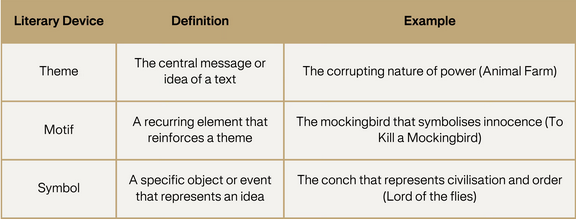
https://www.goldstandardacademy.com/blog/theme-motif-or-symbol-the-ultimate-guide-to-telling-them-apart; accessed on 2026-05-11
Take, for example, James Cameron’s “Titanic”. Here the two protagonists fall in love but due to their different social backgrounds their relationship would never be accepted by their peers. This idea can be retraced to Shakespeare’s “Romeo and Juliet”, where again the relationship between the protagonists is not accepted, due to social differences. The overall theme could be described as love and sacrifice. In “Romeo and Juliet” the theme of love is reinforced by the motif of light (and dark) most prominent in act 2, scene 2.
But soft, what light through yonder window breaks?
It is the East, and Juliet is the sun.
Arise, fair sun, and kill the envious moon,
Who is already sick and pale with grief
That thou, her maid, art far more fair than she.
Although “Titanic” does not clearly feature identifiable motifs, only symbols, it does succeed in establishing the overarching theme which invokes for some parts Shakespeare's “Romeo and Juliet”. In this sense, the literary device of the motif can summon fundamental human experiences which all kinds of artists throughout the history of arts have tried to capture in their works.
How and which fundamental human experiences are conceptualized through art can give an insight into how humanity, guided by mythological stories, philosophy and moral values, perceives the world and how it positions itself within and so acts as a mirror of society. Since there does not exist one universal mythological story or philospohy, an argument can be made that this conceptualization of fundamental human experience differs between cultures. This could justify the study of motifs and themes in Japanese cinematography and retracing them intertextually in order to gain a more nuanced understanding of Japanese art and culture.
In a first instance we tried to understand film motifs, what it entails and how they get meaning. After assuming a first general definition on what film motifs are, we tried to apply this more specifically on Japanese films. In a second, practical phase, we attempted an experiment in detecting visual motifs through the combined use of GenAI and natural language processing (NLP) methods. In a separate essay, one of the results of the practical phase will be taken as a point of discussion to illustrate the implications a motif can have.
Qualitative Research
Before engaging into any quantitative research to gain possible new insights on Japanese film motifs and their associated topics, it is important to define the current related knowledge that is already available. For this reason, an extensive review of the existing literature on Japanese film motifs could form the basis for any other in-depth research that might be performed in the future. This is why this qualitative research has focused on trying to understand film motifs, what they entail, and how exactly they could get meaning. Knowing the scope of this research does not stretch to the general term of motifs itself, but more specifically to their application in Japanese films, after assuming a first general definition on what film motifs are, their implementation in Japanese films was also analyzed. Questions like what possible motifs could be linked to Japanese cinema and how they occur were important factors that carried our research further. By giving a first general impression of film motifs and what is currently known about motifs in the Japanese film industry, the results of the quantitative research can be connected to the existing literature on this topic.
Status Quaestionis
By looking at the currently available research on Japanese cinema, studies have mostly analyzed visual style, cultural meaning and recurring themes, leaving film motifs rather undefined as a distinct concept within the sector. By comparing existing definitions of motifs which were assumed by scholars such as David Bordwell, studies within the Japanese film industry tend to emphasize the development of a unique visual language shaped by history and traditional arts more rather than keeping within the interpretation of a motif as a recurring pattern that gives meaning. This means that the focus of the majority of studies lies within the historical and cultural interpretation of certain individual elements that occur in Japanese films, instead of finding repeated patterns in elements like angles, sounds, objects or sceneries which could represent a greater concept. There are, however, certain concepts within Japanese films that have been extendedly researched by experts such as Yoshiko Okuyama. These concepts are mostly placed into the category of aesthetic as they emphasize the importance of mythology and folklore by demonstrating how elements such as nature and kami function as recurring symbolic motifs. Great examples of such concepts are mono no aware 物の哀れ and ma 間, which explain how meaning is expressed through atmosphere, silence and composition. These concepts will be explained further on.
Next to these concepts, there are studies that have analyzed patterns within specific themes, genres or even directors of Japanese movies like Hirokazu Kore-Eda and Hayao Miyakazi. The results of these studies have shown recurring patterns including minimalism, moral ambiguity, and the beauty of everyday life. As the aim is to define what motifs in Japanese films are, these patterns could have been a great indication for composing a first definition, but this was never the goal of any of these earlier studies seeing how their focus lingers on the interpretation of these patterns rather than defining them. This means that despite a wide range of performed analyses in the existing literature, there can be no clear definition of what a Japanese film motif means distinguished.
Defining Japanese film motifs
Knowing that there currently is no clear definition of what a Japanese film motif encompasses, there could be an attempt to form one by returning to the general definition of a film motif. American film theorist David Bordwell defines a film motif as “any significant repeated element that contributes to the overall form and structure of a film”[^1], meaning that it could be any recurring visual or narrative element in a film that carries meaning and helps to reinforce themes within the film. By recognizing both similarities and differences between repeated elements in films, patterns can be identified, and their evolvement throughout a film can help the viewer gain a deeper understanding of the film's symbolic meaning. This implies that motifs do not only repeat, but also develop, which allows them to highlight contrasts, signal changes, or reinforce connections between scenes.
This is a very broad definition which has led to many different approaches within existing research on films, but with two mainstream approaches standing out. The first approach takes the concept of a motif and applies it on a formal level by looking at the visual elements within a film and trying to understand what they narrate or imply. The second approach takes a different take on the concept by focusing on the interpretation of recurring elements. This translates to the analyzation of their meaning, trying to reveal underlying themes or symbolic associations and possibly connecting them to any cultural, aesthetic, or spiritual traditions.
Based on this general definition of a motif, the meaning of a Japanese film motif could be deterred. Calling a film motif “Japanese” has of course very different interpretations depending on the image one has of what is truly Japanese. A lot of different takes on what is Japanese and what is not, have been extensively used in research before going from traditions in Japanese culture, to geographical or historical rooted explanations. For film motifs, however, it is more valuable to compare recurring patterns in Japanese movies and compare them with patterns defined in foreign movies. By doing so, elements that might be rooted in Japanese culture, aesthetics or the way of filming can be distinguished, as different motifs might occur in Japanese films which do not usually occur in foreign films. So, it is not really about proactively defining what is Japanese and what not, but rather about finding out which motifs are typical for Japanese films through a way of comparison. In this way, a motif can be called “Japanese” when it occurs in Japanese films and is by comparison with foreign film motifs typical for the Japanese film industry only. Bearing this definition in mind, examples of such motifs could be silence, nature, honor… etc. They might not be exclusively used in Japanese cinema but compared to foreign film industries they can be marked as typical for Japanese films as their usage is not only more frequent but might also be connected to certain deeper understandings or images in Japanese culture or history for example.
[^1] Bordwell, D. (2013). Film Art: An Introduction. McGraw Hill.
Mise-en-scène and Japanese film motifs
Now that Japanese film motifs have been defined, placing them in the right context will also provide a valuable contribution to the process of understanding them. Since motifs often appear through visual repetition, it is important to consider the role of mise-en-scène in portraying them. The term “mise-en-scène” literally translates to “what is put in a scene” and refers to everything that appears within the frame of a film. Every element is intentionally arranged to create a particular atmosphere or to help convey the story of a film, such as set design, costumes, lighting, props, and composition.[^2] When looking at Japanese cinema in particular, these aspects play a highly important role in conveying the mood or message of a film, seeing that elements like stillness, emptiness and the presence of nature are often tried to be portrayed.[^3]
This is where the concepts of ma 間 and mono no aware 物の哀れ as mentioned earlier come into play again. The concept of ma 間[^4] refers to any pauses, emptiness or so-called ‘in-between space’ used in both time (e.g. silence in between music notes) and space (e.g. the empty area in a painting), while the concept of mono no aware 物の哀れ[^5] refers to the awareness of the impermanence of life and more specifically the idea that something is beautiful precisely because it does not last. The example of the cherry blossom is often used to explain this last concept, as it is celebrated in Japan not just because it looks beautiful, but because the petals fall shortly after blooming, reminding the observer of the fleeting nature of existence. These concepts illustrate how Japanese films use imagery and space to convey a message, and in this sense use mise-en-scène as a tool to reach a better understanding of recurring elements or motifs like fire and nature.
Inkpaintings or sumi-e are excellent examples for illustrating both these concepts, particularly ma.
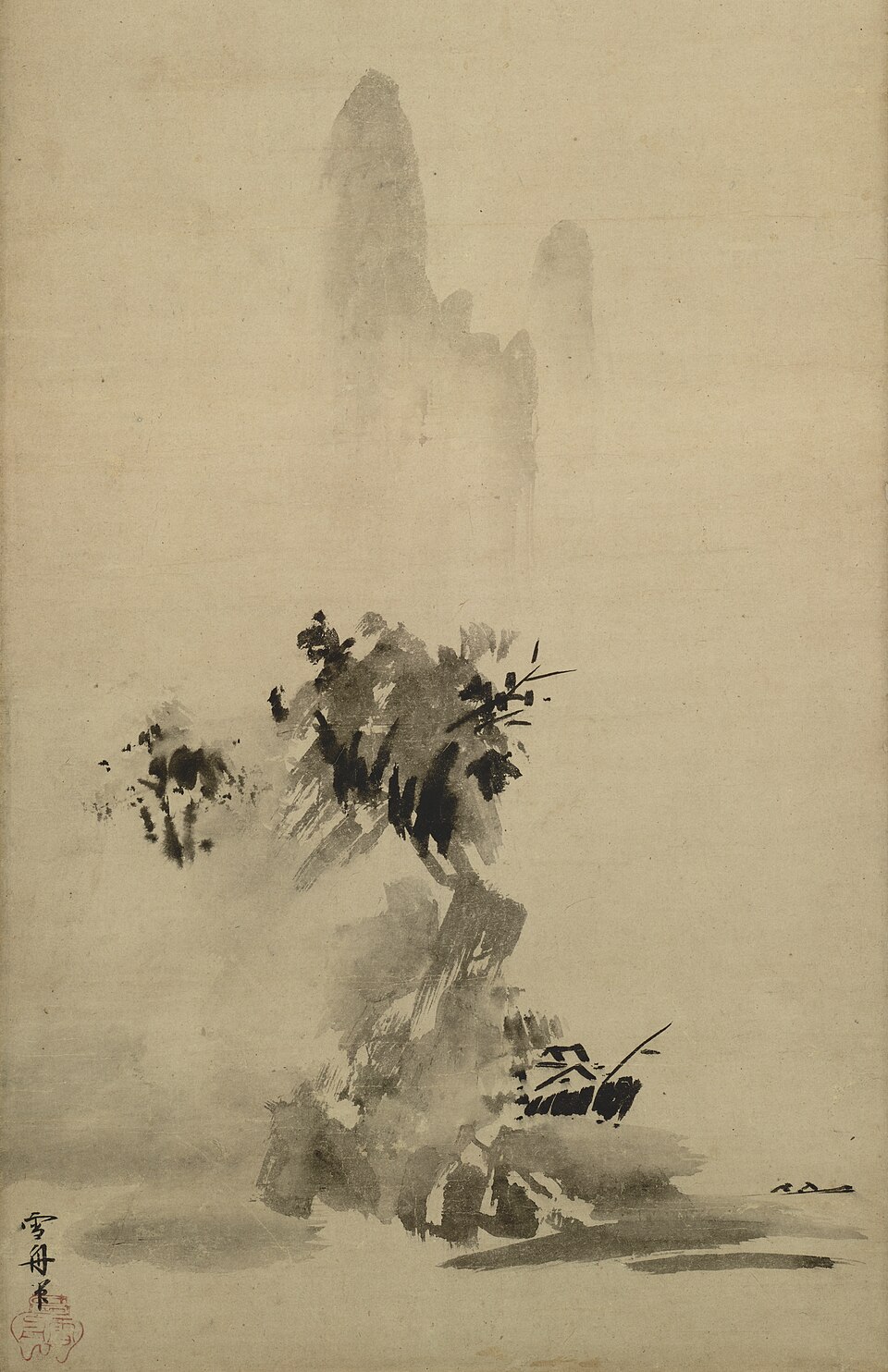
Sesshū Tōyō. English: Sesshu Toyo: Haboku Sansui, 1495. Tokyo National Museum. https://commons.wikimedia.org/wiki/File:SESSHU-Haboku-landscape.jpg

Professor Linda C. Ehrlich demonstrated this usage of mise-en-scène when analyzing film motifs in her article “Turning Away from the Fire: A New Look at Films of Kore-Eda Hirokazu”.[6] By examining the usage of fire as a visual motif across several of Kore-Eda’s works, the positioning of fire within the frame is pointed out, as well as how characters in the film relate to it. When considering all this, it could be concluded that the usage of fire often illustrated a bridge between the past and present, referring to themes like memory, distance, loss, and transformation. So, a film motif – in this case fire – could be given more meaning and context through its mise-en-scène placement.
[^2] Laird, C. (2022). “Japanese Cinema: Mise En Scene.” Youtube. https://www.youtube.com/watch?v=thqWpRdDYVU
[^3] Bordwell, D. (1995). Visual Style in Japanese Cinema, 1925-1945. Film History, 7(1), 5–31. http://www.jstor.org.kuleuven.e-bronnen.be/stable/3815158
[^4] Pellegrini, S. (2023). Further Studies of Temporality in Japanese Film phenomenological reflections on ‘Ma’(間), and the in-betweenness of sound. The Asian Conference on Media, Communication & Film 2023. https://www.academia.edu/112449085/Further_Studies_of_Temporality_in_Japanese_Film_phenomenological_reflections_on_Ma_%E9%96%93_and_the_in_betweenness_of_sound
[^5] Leonard, A. (n.d.). Mono no aware as mise-en-scène. The Cine-Files. https://www.thecine-files.com/current-issue-2/articles/mono-no-aware-as-mise-en-scene/
[^6] Ehrlich. 2019. “Turning Away From the Fire: A New Look at Films of Kore-eda Hirokazu.” Framework the Journal of Cinema and Media 60 (1): 116. https://doi.org/10.13110/framework.60.1.0116
Yasujirō Ozu’s mise-en-scène
The usage of mise-en-scène to create identifiable film motifs in Japanese films can not only be applied to director Kore-Eda Hirokazu but is rather widely used in the Japanese film industry. To be able to illustrate this application of mise-en-scène in further detail, Japanese filmmaker Yasujirō Ozu’s works can be taken as a form of example. In the film Tokyo Story, Ozu uses a technique called “pillow shots”, [^7]which can be explained as static, non-narrative transitional scenes that offer a moment of pause between scenes. They could be seen as a form of ma 間 as they also create a kind of space between scenes, but not necessarily in the literal sense of a blank space, noticing that these pillow shots are often depictions of still lives or spaces devoid of humans such as buildings, trains, bridges… etc[^8]. This technique forms a visual pattern throughout the movie connecting all the pieces and turning them into a total picture, while also having the ability to function as poetic commentary, to foreshadow events or symbolize themes. Concretely in Tokyo Story, Ozu uses this for example by showing a long-timed shot of a closed door after the death of one of the characters, creating space which not only symbolizes the end, but also the stillness that comes afterwards.[^9]
Aside from the concept of ma 間, the concept of mono no aware 物の哀れ – applied as a tool, using imagery and space to create a better understanding of motifs – is something Ozu is very familiar with. Scenes or pillow shots are often used in his films to portray a character or feeling with which viewers are asked to sit with, in order to truly convey the awareness of the impermanence of things or a so-called “sympathetic sadness”. In Tokyo Story for instance, this can be found at the end of the movie where the lingering image of a father who sits at his home, just looking out of the window after losing his wife and seeing his children have returned to Tokyo, makes viewers familiar with the concept of mono no aware 物の哀れ by just having to sit with him for a slightly longer period of time[^10]. In this way, Ozu gives viewers some time to process everything and really feel the beauty behind the ending of things, successfully employing motifs to create a deeper understanding of concepts that are rather just subtly expressed.
[^7] Leonard, A. (n.d.). Mono no aware as mise-en-scène. The Cine-Files. https://www.thecine-files.com/current-issue-2/articles/mono-no-aware-as-mise-en-scene/
[^8] Richie, D. (1959). The Later Films of Yasujiro Ozu. Film Quarterly, 13(1), 18–25. https://doi.org/10.2307/1211232
[^9] Konshak, D. J. (1980). Space and Narrative in “Tokyo Story.” Film Criticism, 4(3), 31–40.
[^10] Richie, D. (1959). The Later Films of Yasujiro Ozu. Film Quarterly, 13(1), 18–25. https://doi.org/10.2307/1211232
Themes within Studio Ghibli
Having accumulated a certain understanding of Japanese film motifs and the context in which it could be placed, it might be relevant to look at another concept that is often confused with film motifs. Screenwriter Cannistraci (2025)[^11] has defined a theme as an underlying message or larger idea that a piece of writing or film is conveying. It is often associated with a moral or the reader’s takeaway from what has occurred in the narrative such as “good vs evil” and “power and corruption”. This is sometimes confused with the plot of a film, which conveys purely the narrative and is more about what the story is on the surface. Films can have multiple themes which will usually appear periodically throughout the narrative and can appear in various ways and with different techniques, using images and soundtrack cues among other things like certain situations repeating themselves, characters discussing the theme, character arcs emphasizing it… etc. Based on this definition, themes are closely related to the underlying message of the full story of a film while motifs rather represent certain elements, images or angles which could stand for concepts that are not necessarily related to the narrative as a whole. Themes are broader and do not have a strictly reoccurring pattern, in contrast to motifs that are defined by it and could occur in films with totally different themes.
As film motifs have been applied to the Japanese film industry, the same can be done for film themes. To obtain a greater understanding of these themes, one of the greatest Japanese film studios will be analyzed, creating opportunity for more practical examples. Getting some knowledge on the Studio itself first, could offer more valuable insights and comprehension of themes that are expressed in their films. Studio Ghibli was founded in 1985, and its movies have since then been widely discussed among all generations. Co-founder and film producer Hayao Miyazaki is well-known for always bringing a sense of nostalgia and a peaceful atmosphere in his movies, and has been receiving awards for his well-known Ghibli animations and character stylization since the release of their first official movie, Castle in the Sky in 1986. While Nausicaä of the Valley of the Wind (1984) is often associated with the studio, it was produced prior to its official incorporation. Some of Studio Ghibli’s most popular movies include My Neighbor Totoro (1988), Kiki’s Delivery Service (1989), Princess Mononoke (1997), Spirited Away (2003), Howl’s Moving Castle (2004), and Ponyo (2008).

Studio Ghibli, promotional poster for the movie Princess Mononoke (もののけ姫 *mononoke hime*), https://www.ghibli.jp/works/mononoke/#frame accessed 16-05-2026
Taking the example of Studio Ghibli’s latest release, The Boy and the Heron (2023) has won an Oscar for Best Animated Feature, among other prizes like the Golden Globe Award and BAFTA Award for Best Animated Feature. The movie explores grief, acceptance, and the transition from childhood to maturity, which are recurring themes in Studio Ghibli movies. The story follows an eleven-year-old boy named Mahito Maki who lost his mother in a hospital fire during the Tokyo firebombing. A year later he moves to the countryside with his father, who has married Natsuko, his late wife’s sister. Mahito, who has a rather distant relationship with Natsuko, encounters a grey heron leading him to a mysterious sealed tower. The heron claims his mother is still alive and waiting for him, after which Mahito experiences various magical incidents, leading him eventually into getting transported to another world where he meets multiple mysterious characters.
This movie, like many others by Miyazaki, also has hints of folklore and mythology in it. For example, in Japanese folklore, herons are associated with spirits, death, and other worlds. They are seen as divine creatures that traverse earth, air, and water, serving as messengers between worlds. The heron’s true form is based on the Aosagibi, a yōkai (monster) out of Japanese folklore that tells tales of a heron that glows with blue fire, which was believed to be a ghostly shapeshifter. It occurs rather often that mythological creatures inspire characters in Studio Ghibli, adding more depth and creating possible hints to underlying themes. The Boy and the Heron is, apart from the story that can be seen on the surface, a complex tale with themes like choosing the painful, real world over an idyllic, artificial one, ultimately answering the question "How do you live?" by accepting life's inevitable losses. This question can not only be found by trying to understand the deeper meaning of the narrative, but it is also the literal translation of the movie title in Japanese “君たちはどう生きるか” (Kimitachi wa Dō Ikiru ka).
Miyazaki’s movies have been analyzed by many, whether that be in academic circles or hobbyists who like to delve deeper into the world of Studio Ghibli by themselves. Adam Dobay (2021)[^12], an independent film analyst who specializes in film storytelling and story patterns for example, has crafted a blog named “The Moon Rabbit”, with which he aims to reveal new ways to look at widely praised works of film. With his background in mythology and screenwriting, he wants to help people acquire new insights into films that have had an immense influence on their lives. These films have also reached the scope of Miyazaki, leading to Adam Dobay defining three closely linked, recurring themes in Miyazaki’s life work: wind, women, and revolution. Bearing in mind that Studio Ghibli movies often hide some kind of political message, Dobay believes Miyazaki’s view on the source of what has led Japan to its defeat in the Second World War could be deterred from his films. He found that the structure of a society based on hierarchy, aggression, the oppression of the weak by the strong, and an overreliance on technology was the reason Miyazaki had in mind. As a solution, Miyazaki proposes empowering women as he finds that this will lead to a more balanced society in terms of exemplary traits he associates with women, like fairness, inclusion, but also wit, practicality, perseverance, and hard work. He also hints that empowering women might lead to a reconnection with the natural world, which is mystical, mythological, and overall better than the current world humanity has managed to build. Nature has balance, and so should human society. This ties the concept of equality together, in terms of gender, as well as class. Dobay believes the best way to reach all generations with this message is through popular films.
[^11] Cannistraci, E. (2025, 9 december). Dive deeper: What is theme in film? Final Draft - Screenwriting Software. https://www.finaldraft.com/blog/dive-deeper-what-is-theme-in-film
[^12] Studio Ghibli Storytelling - Follow the Moon Rabbit. (2021, July 25). Follow the Moon Rabbit. https://www.followthemoonrabbit.com/studio-ghibli/
Quantitative Research
Now having established a certain understanding of motifs and how they might be applied in the Japanese cinematographic scene, it could be considered a solid basis for further research. As there has not been done extensive research yet on motifs and their meaning for the Japanese film industry, a further deepening on the matter might be able to detect certain motifs that could be described as typical for Japanese films. As film motifs are only a small part of a bigger cultural and historical picture, just as much as it is technical, trying to place them in the right context will prove to be a difficult challenge, but equally important at the least. The goal of this research is to establish a method that makes it possible to detect potential motifs in films, keeping in mind the possibility of automatization of the process in the future. Relying on this process, a more specific aim of defining motifs in Japanese films will be at the center of this research. By applying methods of topicalization to the results that come out of the process of describing Japanese film motifs, clusters of motifs will be then tried to put together under the same concept, that could illustrate a deeper meaning that goes beyond the technical features of a motif. In this way, underlying elements of Japanese culture, history or spiritual beliefs might be detected without ever being noticed before, connecting film techniques with symbolism in Japanese cinema. As this is rather small-scale initiated research, it could provide a starting point for the development of a large-scale analyzation of different film techniques, genres, and even industries. This is why the main goal of this research is to establish a hands-on analyzation process which can be used as a stepping-stone for later research, but also to provide a first insight on Japanese film motifs and their possibly related topics.
Research Question
Before getting started with the construction of a research method, the need for a defined research question is fundamental. As this study’s goal is to provide new insights on Japanese film motifs, it is useful to return to the definition of it, which was established in the qualitative research. The pronounced need for comparison with foreign film motifs in order to mark a film motif as “Japanese”, is a prominent aspect that asks for careful consideration when trying to identify said motifs. Another important factor that needs to be taken into account is the need for connecting meaning to motifs, by clustering motifs underneath a collective term that refers to the concept they all represent. As this clustering can be done via topicalization, these represented concepts will be getting the term of “topic” in the remainder of this study.
Now that the two most important factors that influence the course of this study have been identified, a first research question can be put together. Since this study represents a form of popular culture in Japan, it was useful to look at it from a foreign point of view, trying to form an image of Japanese popular culture as it is perceived by outsiders. This also relates back to the need for comparison with foreign films, so after careful consideration the following research question was formulated:
“What are the most well-known topics in Japanese films in foreign countries until 2025?”
After brainstorming more about how to answer this research question, taking into account possible research data that can be used, the question of how to determine which Japanese films are representative for the prominence of Japan-related topics in foreign countries was raised. Following this deliberation, a second research question was formulated that tried to evade any sort of ambiguity that the term “well-known” carries:
“What topics occur in the highest-grossing Japanese films outside of Japan until 2025?”
This formulation will be the final version of the research question, but a few limitations that are connected to it must be mentioned as well. By taking the highest-grossing Japanese films as the most representative for being well-known in foreign countries, it is assumed that the published (official) sales figures are representative for global recognition, while aspects like watching movies via other channels – may they be unofficial or even illegal – that are not included in the sales figures have not been considered. The sales numbers themselves could also be vulnerable for inconsistencies that could lead to incomparableness between films from different years or that are owned by different film studios, like different price-setting techniques, different profit margins and inflation.
Methodology
After establishing the research question, a proper research method can be constructed. As mentioned before, a lot of attention will be put into the methodology itself to try and establish a process that could identify motifs in films in a way that allows for valuable interpretations. Keeping this in mind, as well as the research question, the first step of the research would be to identify the highest-grossing Japanese films outside of Japan until 2025. Knowing that there are statistical databases on films like the Box Office Mojo by IMDbPro[^13], containing numbers of box office earnings at cinemas, these databases will be used to determine the list of highest-grossing Japanese films. If it is deemed necessary, the website(s) of these databases will be scraped for every film that turned out to be amongst the highest-grossing Japanese films. Considering that the debuting year, genre and producers might have a connection to the final results of the research, getting these records per film could be an asset for the interpretation of these results. For the scraping, the tool OutWit Hub will be used, after which the scraped data will be put in OpenRefine as it allows for more analytic functions that might turn out to be useful to make more associations that are linked to the results.
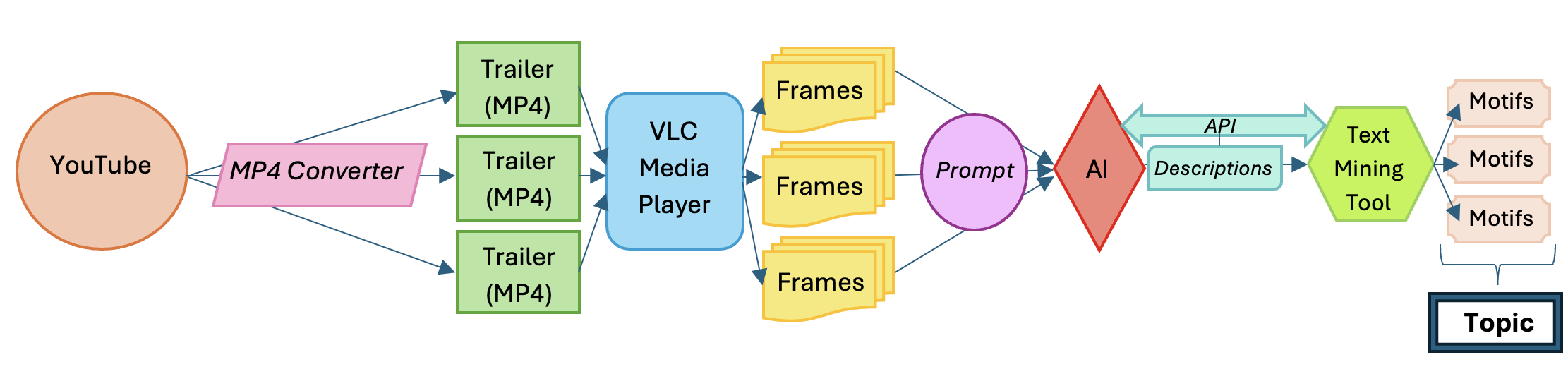
After getting the information on the films that are needed to base the research on, the real construction of the process on retrieving motifs can start. First, the source for getting the films as video files (MP4) in the system, had to be decided upon. As this is only meant to lay a basis for large-scale research with only limited tools available, YouTube will provide the videos of the films. If the full-version films would be analyzed, a lot of work, time and database storage would be needed. As these resources are not fully available, it was decided that only the trailers of the films would be analyzed, which is also in accordance with the scale of this study. This will of course form another limitation to this research as a lot of context will disappear and the possibility that motifs that appear in the movies are not represented in the trailers will occur as well. However, for constructing and testing the process to determine motifs and topicalize them, the usage of trailers will suffice.
Since these trailers are available on YouTube but not yet in an editable MP4-format that can be used to pull frames, these trailers will be converted to the right format first. To do this, the video converter website Free MP3 Converter[^14] will be used to convert the YouTube video to a downloadable MP4 file. At the time of usage, both conversion to MP3 and MP4 were available, but since May 2026 this functionality has been discontinued on the website.
To be able to identify motifs within the trailers, there are frames needed that can be analyzed. The reason the decision was made to rely on frames instead of moving images, was because describing a moving image will often result in only contextual clues like the movement or action of a person, without taking into account the position of the camera angle, the background or unchanged elements like the way a house is standing in a landscape for example. For the identification of a motif, however, all these aspects are important factors. Getting these frames out of a video, there are two ways to do this: frames can be manually established by taking screenshots after a certain interval of time or a tool can be used to automize this process. As the goal is to define a process that can be used for bigger projects in the future, this asks for a tool that has the ability to split a video into countless of frames in an automized manner. One of these tools is VLC Video Player, which seemed to be the most accessible and workable tool for this project and was chosen for this exact reason.
The difficult part of getting this process of identifying motifs to work, is establishing the way frames are described. The description needs to factor in as many elements of the frame as possible, to be able to find relevant connections and patterns that later might be called a motif. This can of course be done manually, letting someone analyze every frame and write a description for each of them by hand, but this can cause some issues on the long term. First, this kind of work calls for consistency in the descriptions, which would only be possible if the same person was writing all of them. Imagining the number of frames that need to be analyzed, this would take an enormous amount of time and effort which, again, undermines the goal of automatization. Second, the input of any person conducting research will always result in some kind of subjectiveness, which is also not desirable. For these aforementioned reasons, the descriptions will not be done by a person but by using AI. The frames that were received from the VLC Player will be uploaded in an AI with the request to make detailed descriptions of each individual frame. These descriptions will then be collected and compiled in a separate document for each trailer, numbering every frame described in the right order of appearance in case a certain description or frame needs to be found or referred to.
As for the next step, based on the given descriptions, reoccurring elements that might be called motifs have to be identified. To do this, the idea is to use natural language processing (NLP) methods via a text mining tool that is specialized in topic modelling, to allow for deterring reoccurring elements from the descriptions and giving meaningful insights on them, like how many times they occurred in the trailers. This way, motifs can not only be identified throughout the trailers using patterns and recurrence, but topicalization can also be applied in a later step. If motifs are found within a certain context multiple times, they can be placed under the same term that describes this context, successfully marking them as a topic. By matter of comparison, the different topics that come out of each trailer can be put next to each other in order to find possible reoccurring topics or connections between movies, genres or directors. To do this, the topicalization will have to be performed manually, considering that the matching of contexts has a need for interpretation and possible background knowledge on culture, traditions and history.
To apply the automatization aspect on the descriptions and text mining, the goal is to connect the text mining tool with the AI that produces the descriptions by using an API. GenSim[^15] is a Python library for topic modelling, document indexing and similarity retrieval with large corpora, and will be used as the text mining tool. Because it allows for a code to be written via Python that can retrieve information directly from the AI using an API, it fits the automized connection purposes. Using this method, most motifs will be automatically identified in GenSim via topic modelling and only the manual topicalization will be left as a last step in the process.
If the whole process of identifying the motifs and possibly deterring topics is visualized, it would look like this:
[^13] IMDB | Help. (z.d.). https://help.imdb.com/article/imdbpro/industry-research/box-office-mojo-by-imdbpro-faq/GCWTV4MQKGWRAUAP?ref_=mojo_ftr_help#
[^14] Ytmp3.gg. (2025). MP3 Converter. Free MP3 Converter. Consulted on 30th April 2026, on https://media.ytmp3.gg/
[^15] gensim. (2025, 18 oktober). PyPI. https://pypi.org/project/gensim/
Research Process
Following the structure of the methodology, first, a list was established of the highest-grossing Japanese films worldwide[^16]. This list was based on box office earnings at cinemas according to data from Box Office Mojo but does not consider other sources of income related to the films, such as merchandising or home video. Neither does it include English-language international co-productions between Japanese and Hollywood studios, as the aim is solely Japanese films without any interference from Hollywood. The list is supposed to be an all-time overview of Japanese films, but data from films released prior to 1997 is limited so it might not be complete.
| Rank | Title | Worldwide gross | Year | Format |
|---|---|---|---|---|
| 1 | Demon Slayer: Infinity Castle † | $800,100,000 | 2025 | Anime |
| 2 | Demon Slayer: Mugen Train | $512,704,063 | 2020 | Anime |
| 3 | Your Name | $405,349,022 | 2016 | Anime |
| 4 | Spirited Away | $395,580,000 | 2001 | Anime |
| 5 | Suzume | $314,992,206 | 2022 | Anime |
| 6 | The Boy and the Heron | $294,200,000 | 2023 | Anime |
| 7 | The First Slam Dunk | $279,045,965 | 2022 | Anime |
| 8 | One Piece Film: Red | $246,500,000 | 2022 | Anime |
| 9 | Howl's Moving Castle | $237,536,126 | 2004 | Anime |
| 10 | Princess Mononoke | $231,255,044 | 1997 | Anime |
| 11 | Ponyo | $204,826,668 | 2008 | Anime |
| 12 | Jujutsu Kaisen 0 | $196,200,000 | 2021 | Anime |
| 13 | Weathering with You | $193,715,360 | 2019 | Anime |
| 14 | Chainsaw Man – The Movie: Reze Arc † | $186,671,780 | 2025 | Anime |
| 15 | Stand by Me Doraemon | $183,442,714 | 2014 | Anime |
| 16 | Pokémon: The First Movie | $172,744,662 | 1998 | Anime |
| 17 | Bayside Shakedown 2 | $164,450,000 | 2003 | Live-action |
| 18 | Detective Conan: One-eyed Flashback | $162,042,074 | 2025 | Anime |
| 19 | Detective Conan: The Million-dollar Pentagram | $150,008,115 | 2024 | Anime |
| 20 | Arrietty | $149,692,197 | 2010 | Anime |
| 21 | The Wind Rises | $136,864,780 | 2013 | Anime |
| 22 | Pokémon the Movie 2000 | $133,949,270 | 1999 | Anime |
| 23 | Detective Conan: The Fist of Blue Sapphire | $123,009,017 | 2019 | Anime |
| 24 | Dragon Ball Super: Broly | $122,740,616 | 2018 | Anime |
| 25 | Detective Conan: Black Iron Submarine | $121,879,597 | 2023 | Anime |
| 26 | Godzilla Minus One | $116,478,355 | 2023 | Live-action |
| 27 | Bayside Shakedown | $115,000,000 | 1998 | Live-action |
| 28 | Kokuho † | $109,099,170 | 2025 | Live-action |
| 29 | Detective Conan: Zero the Enforcer | $107,918,046 | 2018 | Anime |
| 30 | The Adventures of Milo and Otis | $104,121,749 | 1986 | Live-action |
| 31 | Detective Conan: The Bride of Halloween | $102,599,093 | 2022 | Anime |
| 32 | Detective Conan: The Scarlet Bullet | $102,541,282 | 2021 | Anime |
| 33 | Antarctica | $101,000,000 | 1983 | Live-action |
| 34 | Haikyu!! The Dumpster Battle | $100,255,784 | 2024 | Anime |
| 35 | Yo-kai Watch: The Movie | $99,481,307 | 2014 | Anime |
| 36 | Umizaru 3: The Last Message | $98,663,381 | 2010 | Live-action |
| 37 | Dragon Ball Super: Super Hero | $97,242,192 | 2022 | Anime |
| 38 | One Piece: Stampede | $94,000,000 | 2019 | Anime |
| 39 | Evangelion: 3.0+1.0 Thrice Upon a Time | $93,882,453 | 2021 | Anime |
| 40 | Brave Hearts: Umizaru | $91,884,352 | 2012 | Live-action |
| 41 | Rookies: Graduation | $88,055,243 | 2009 | Live-action |
| 42 | Nodame Cantabile: The Movie II | $86,192,740 | 2010 | Live-action |
| 43 | Bayside Shakedown 3 | $85,347,374 | 2010 | Live-action |
| 44 | One Piece Film: Z | $84,936,585 | 2012 | Anime |
| 45 | The Eternal Zero | $84,500,000 | 2013 | Live-action |
| 46 | Shin Godzilla | $82,622,468 | 2016 | Live-action |
| 47 | Doraemon: Nobita's Treasure Island | $80,920,916 | 2018 | Anime |
| 48 | Hero | $80,400,000 | 2007 | Live-action |
| 49 | Code Blue: The Movie | $78,778,562 | 2018 | Live-action |
| 50 | Tales from Earthsea | $75,500,000 | 2006 | Anime |
| 51 | Thermae Romae | $75,387,554 | 2012 | Live-action |
As is shown in the table above, there are 51 Japanese films listed with release years ranging between 1983 and 2025 and with anime or live-action formats. These movies will form the basis of this research, meaning that the trailers will be used to look for motifs and resulting therefrom possible topics. When looking up any film trailer on YouTube, an obstacle will present itself in the form of not just one, but multiple trailers per film. Following this, a decision had to be made on how to determine what movie trailer would be used for further analyzation. Referring to the original research question, which goal was to identify the most well-known topics in Japanese films in foreign countries, the trailer with the highest viewer rate on YouTube was decided upon for every film. The next step of converting these videos to downloadable MP4 files, went smoothly without any issues.
Now that the stage where videos are split into frames has been reached, a small matter that needed some extra thought had presented itself. When using VLC Player to split a video into frames automatically, a choice has to be made concerning the number of frames per second. After discussion, it was set to 2 frames per second, keeping in mind that a valuable frame might be missed when fast moving scenes occur. On the other hand, are too many frames not desirable as it would give the same frame over and over again, possibly influencing results. For this reason, two frames per second seemed like a mediated choice. There was a small struggle with trying to assign a folder on the computer where the frames would automatically be uploaded to once the settings of the frames were on and the video was played again, but by explicitly adding the folder in the settings and closing and opening VLC Player again, it eventually worked. When wanting to speed up the process, another laptop was tested but extra attention was needed for the difference in user interface between a Windows-driven and iOS-driven device.
After the trailers were successfully split into frames, the number ranged between 156 to 278 frames per trailer. These are quite high, knowing that they also take up space on the hard drive. The real challenge now, however, was finding a tool that had the ability to describe as many frames as possible and do so in the most objective way, so our data would remain uninfluenced. After trying out multiple commercial AI tools online, like Copilot and Gemini, it was decided that the best tool in this case would be ChatGPT[^17], in terms of allowing all frames to be uploaded and with what speed. There was access to ChatGPT Plus available, which turned out to be convenient when it comes to the number of files that could be uploaded in one go. Not only did it give the possibility to upload a high number of frames – approximately 75 – after which the user has to wait for about two to three hours to continue sending more prompts, but the description also turned out to be the best quality between all the tools that were tested.
Nevertheless, ChatGPT had a couple of limitations that had to be taken into account or worked around. At times it would not stick to the prompt, change the style, give a different output than requested, ignore random frames or double others. Generally, if only 8 frames at a time were uploaded, everything would work smoothly. But whenever around 12 or 16 frames would be uploaded on the other hand, the above-mentioned problems occurred. That is why, at times, it was necessary to ask ChatGPT to stick to the prompt again or even start new chats if that did not work, which created lots of extra work. This is the reason that after careful deliberation, the project had to be narrowed down to text-mining 6 trailers instead of the full 51 that were initially planned. As a matter of representation, it was decided that this selection of films would remain with 2 Studio Ghibli movies: Spirited Away and The Boy and The Heron, 2 live-action movies: Bayside Shakedown II and Godzilla Minus One, and lastly 2 anime movies: Demon Slayer: Infinity Castle and One Piece: Red.
ChatGPT was initially asked to describe the frames with the following prompt:
“I'll upload some frames and I need you to describe them for me as objective as you can (it is meant for text mining later on...) but I simply need the description in a continuous text per frame. In case any subtitles occur, ignore them please.”
This caused the AI to describe the frames as detailed as it could – even though some descriptions turned out to be shorter for the same frame as it continued to describe more frames – leaving a document full of descriptions. Following the proposed research process, there had to be written a code in Python to make it possible to connect GenSim and ChatGPT using an API. When looking at the user- and installation guide of GenSim, a lot of packages had to be installed and unpacked, in order to work properly (Gensim, 2025). As there was no one who had any experience with the tool, there were some inconveniences that occurred with installing all the necessary materials, before even being able to use it. For this reason, people who had a background in coding were asked for a second opinion on what tools to use for text mining. This eventually altered the course of the research process, as from now on the web-based tool called Voyant Tools[^18] would be used for text-mining and analyzation purposes. It allows for the reading and analyzation of digital texts in an interactive way, making it possible to create a variation of comparisons in different forms, like a cirrus for example. As this would prove itself convenient for the topicalization purposes of this research, the need for the automatization aspect did not outweigh the functionalities and user friendliness of Voyant Tools. The scale of this project was in the meantime also downsized a bit further after lowering the amount of trailers to 6, due to prompt limits linked to AI-usage, making it less work to compile a document for every trailer with all the descriptions ChatGPT had managed to produce.
After trying it out on a first test trailer (Demon Slayer: Infinity Castle) and feeding the results to Voyant tools, the realization came that by receiving full sentences as a response from ChatGPT, too many technical words such as “background” and “visual” were used in the description, gravely influencing the outcome and producing results that were barely useful.
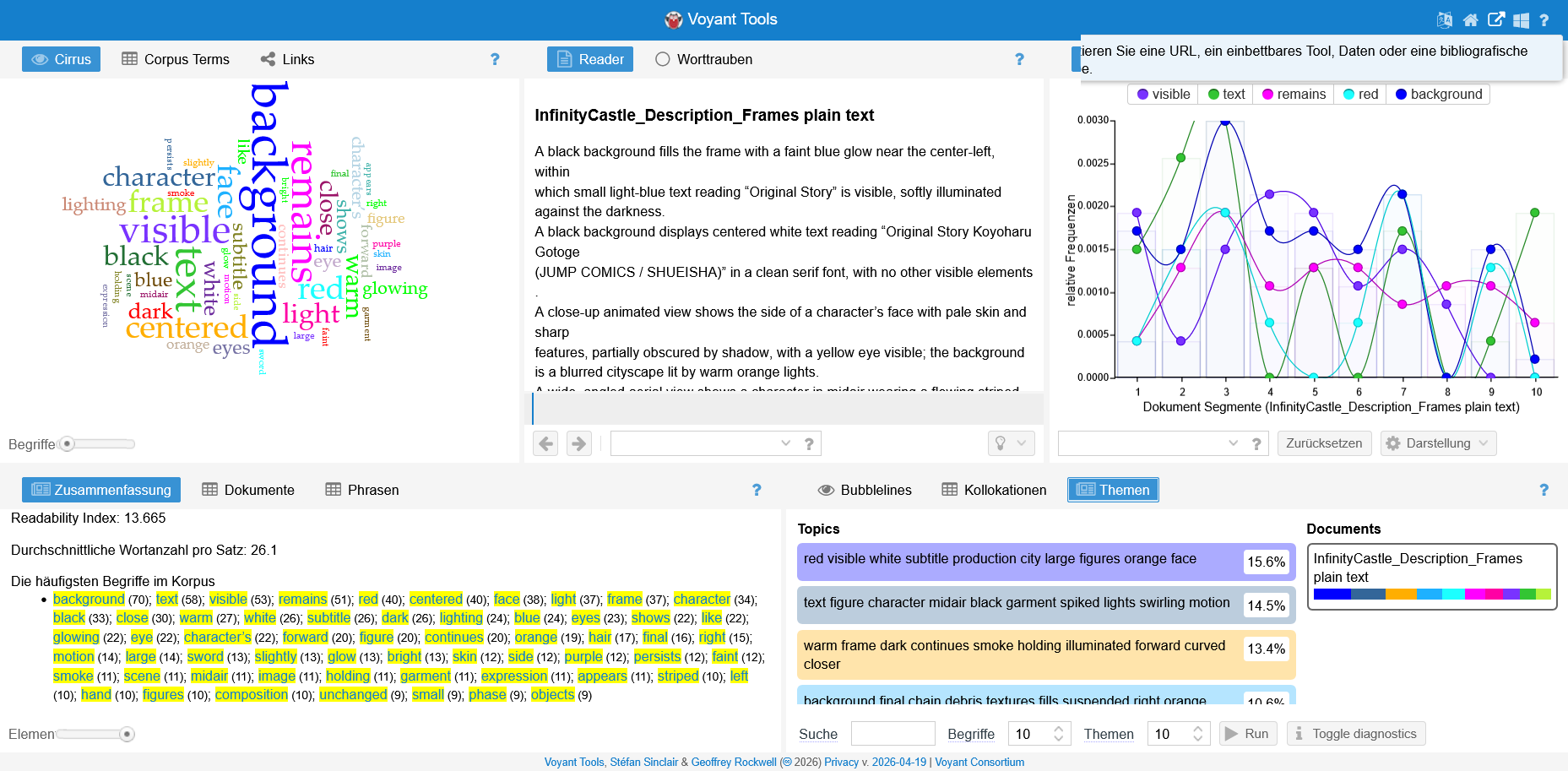
After using the function that can compare phrases, with the ability to choose the number of words it has to cluster together, a list was created where clusters of two words were compared in order to provide more context and hopefully getting rid of any technical description words. This provided a bit more context and room for interpretation but eventually stayed rather vague.
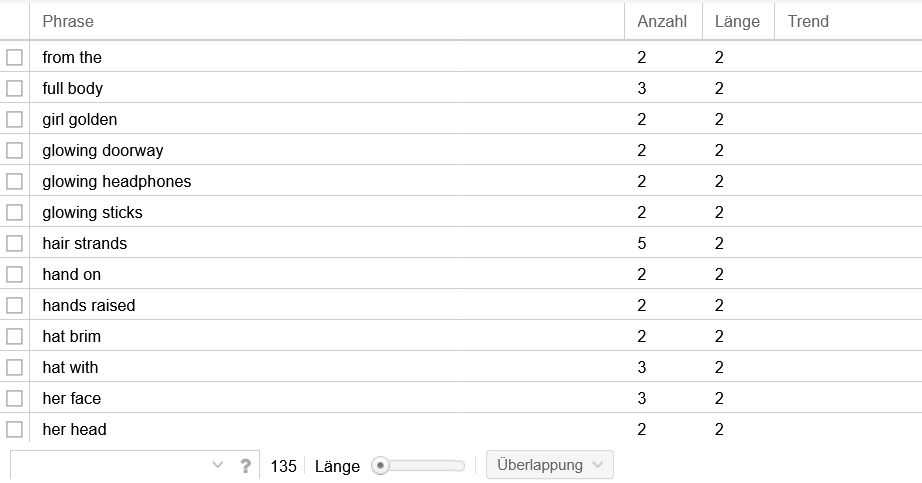
Noticing that these results were not that useful either, a new prompt had to be designed with attention to relying purely on singular words or clusters of words, in order to gain more contextualized data. After trying a couple of alternatives, the following prompt was decided on:
“I will upload some frames, could you describe those only using clusters of words of everything you can distinguish per frame? If any subtitles occur, please ignore them.”
Surprisingly, for the majority of time, ChatGPT has not only managed to articulate more useful output but also managed to stick more to the prompt compared to the deviations it performed on the original one, by ignoring less frames for example. This provided more efficiency and less waste of time, but it is still unclear what exactly about the prompt made ChatGPT work differently. This does not mean, however, that even with all these changes ChatGPT did not have to be corrected anymore. It would continue to add or ignore some frames, but much less than before.
| Movie Trailer | Description process of the frames |
|---|---|
| Demon Slayer: Kimetsu no Yaiba – Infinity Castle | 181 Frames: No issues, all frames were described. |
| Bayside Shakedown 2 | 155/156 Frames: 1 frame was ignored. |
| The Boy and the Heron | 163/191 Frames: 22 frames were intentionally omitted (due to the mention of American voice actors appearing on screen), resulting in 6 frames missing. |
| Spirited Away | 243/278 Frames: 35 frames were ignored. |
| One Piece Film: Red | 178/178 Frames: ChatGPT no longer worked frame by frame and instead provided a general content description of the anime. Multiple new chats had to be created to generate a new iteration. |
| Godzilla Minus One | 223/203 Frames: ChatGPT creates descriptions for 10 frames instead of the requested 8, and the last frame is split into 3 descriptions. 20 unnecessary frames were manually removed. |
An example of the descriptions created by ChatGPT, using the new prompt:
Frame 1
black background, deep darkness, faint blue glow, soft light bloom, small centered text, minimal composition
Frame 2
black background, white serif text, centered layout, clean typography, high contrast, empty surrounding space
Frame 3
close-up face, sharp yellow eye, pale skin, dark hair strands, intense gaze, warm orange lighting, sparks, blurred city lights background
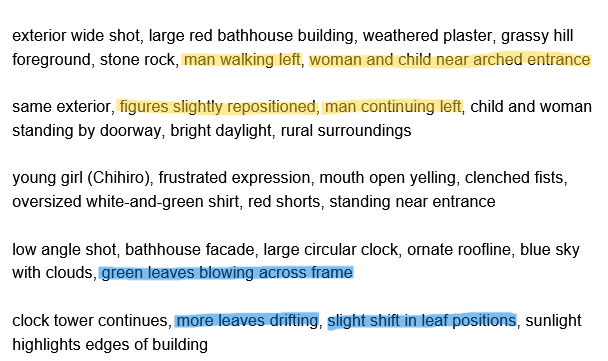
Another interesting observation that can be taken from the produced descriptions is that ChatGPT has the ability to notice sequences in frames that it receives. Frames were always uploaded in the order they were originally retrieved in from VLC Player – which was always chronological – and looking at the descriptions that were produced, the AI made connections with other frames that were uploaded earlier. Even though the frames were just images, ChatGPT had noticed that some action that started in one frame, was continued in the next. Some examples to illustrate this:
[^16] Wikipedia contributors. (2026, 24 april). List of highest-grossing Japanese films. Wikipedia. https://en.wikipedia.org/wiki/List_of_highest-grossing_Japanese_films#References
[^18] Tutorial: About | Voyant Tools help. (z.d.). https://voyant-tools.org/docs/tutorial-about.html
Results
The final results that came out of Voyant Tools for the six trailers have a mixed sense of meaning. Now that the interference of supporting words used in a fully written description have been filtered out, there could be actual motifs and topics detected. They are, however, still rather vague and in dire need of context. Considering the analyzation has only been applied on trailers, it could still be logically explained. Full-length films have longer scenes, provide more context and do not have the same purely marketing-related goal. For this reason, more meaningful results can be expected from the analyzation of full movies compared to the trailers. This does not mean that this research based on only trailers does not give any indication of how motifs could be assigned.
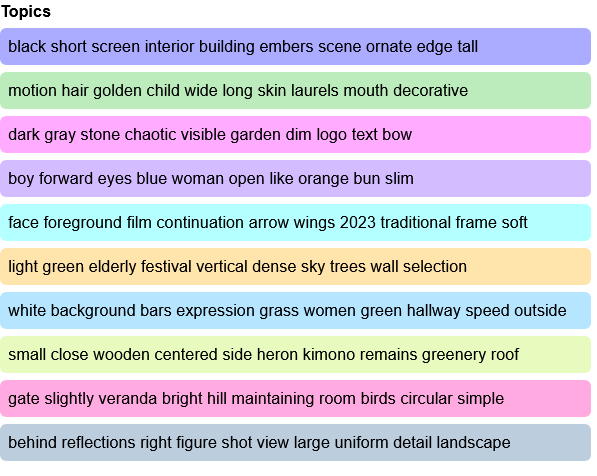
Taking the example of The Boy and the Heron, Voyant Tools had the ability to cluster similar recurring elements, which could be called motifs, introducing possible topicalizations. Even though they do not seem to be any meaningful topics yet, it does illustrate the capacity of recognizing motifs and assigning topics if more context is added.
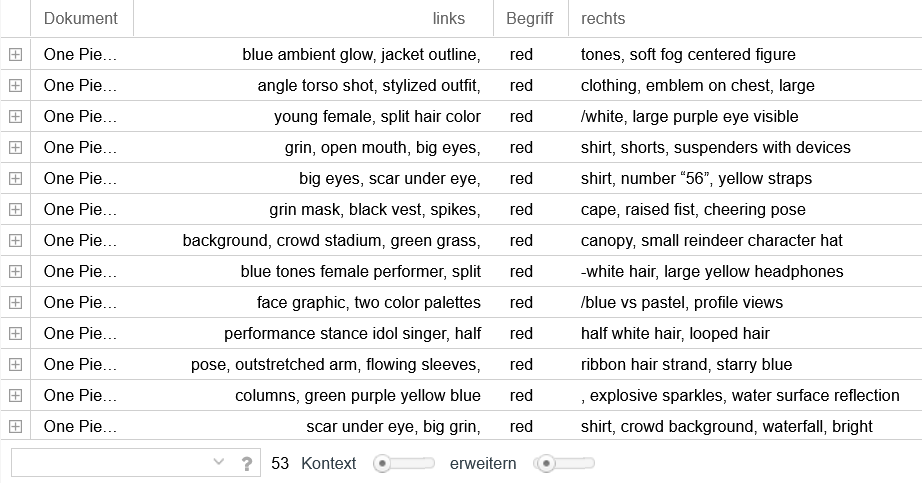
Another tool that Voyant Tools introduces is the ability to add more context by showing what words often occur before or after a word with a high occurrence frequency. Taking the word red out of the descriptions for the trailer of the film One Piece for example:
Returning to the justification for using these six trailers, overlapping elements were the key factors in making this decision. This was for comparison purposes after text-mining, which Voyant Tools also offers in its tool package. There were three kinds of overlap that were embedded in the choice of trailers: Live Action films, Manga Adaptations and Studio Ghibli. As two movies have an overlapping factor, it might be useful to see whether or not similar patterns could be deterred. It might also give more meaning and context to the identified motifs, allowing for topics to be assigned easier.
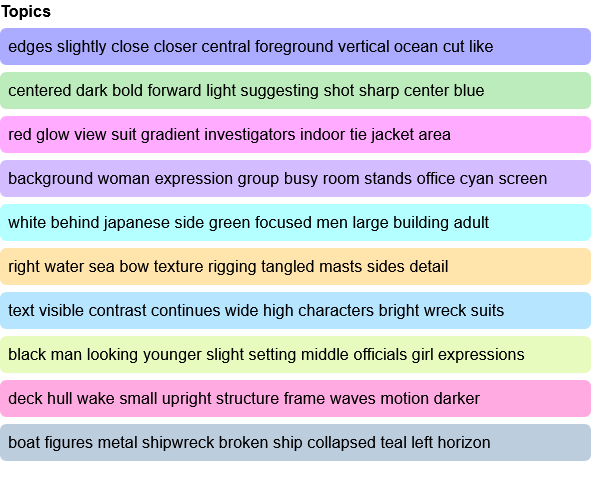
Combined topics Live-Action films
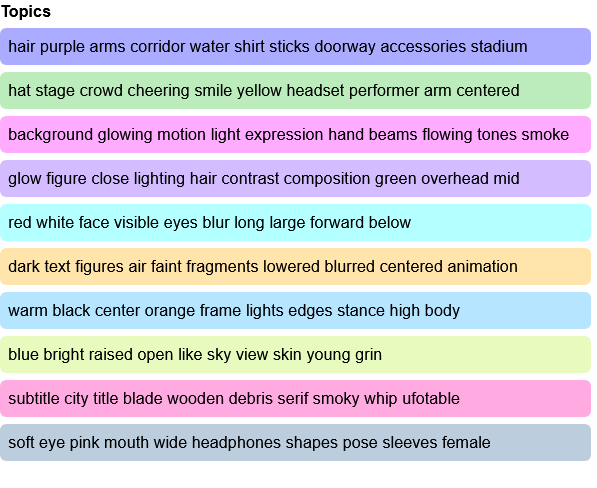
Combined topics Manga Adaptations
Combined topics Studio Ghibli
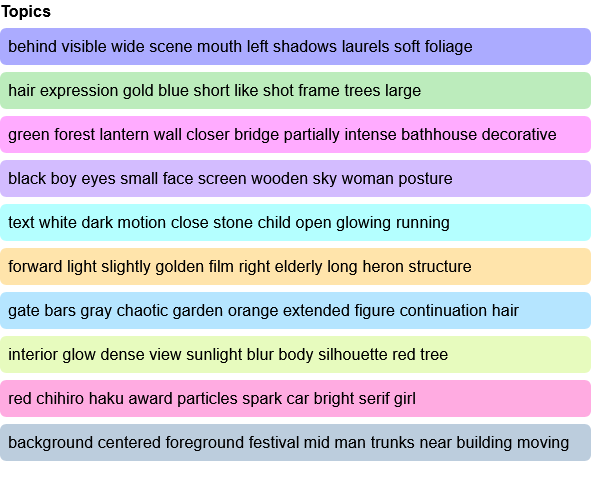
Even though these clusters of information retrieved from the frames are still quite vague, the sense of the trailer and indication to the kind of movie can already be made out with a bit of creativity. The assignment of topics has, as said before, quite the need for interpretation regarding background on culture, film techniques, history and traditions, so it will always contain some trail of subjectiveness. Taking the comparison of the two live-action film trailers for example, Voyant Tools has identified motifs that contain elements of background, woman, expression, group, busy, room, stands, office, cyan and screen. Using some imagination, a picture of said description can be formed where a woman stands in an office looking at her screen with a thoughtful expression, where other people in the office are working and talking, making the background seem very busy. When imagining this, a possible topic could be assigned under the term “office” for example. It might be that the office is always pictured as a busy workplace and considerably stressful, taking in the expression of the woman. Whether this is a topic that could be labeled specifically to Japanese films will remain a question, until topics retrieved from foreign films are compared.
As this research was meant as a proposition for a possible research procedure that aims to identify motifs and possible related topics, the originally proposed process should be returned to. While applying the theory of the process, some practical alterations have been made along the way. Even though the automatization using Python to connect GenSim and ChatGPT can still prove to be valuable in future research, its need for technical knowledge and resources was outside the scope of this research. Using ChatGPT and Voyant Tools, however, has proven itself as a proper steppingstone with a lot more potential. If there is a possibility to apply this on full-length movies, the results could make for very varied interpretations and possibly connections that have some deeper-rooted meaning. The process that was altered after testing can be presented as the following:

Conclusion
The aim of this research was to propose a methodology that makes it possible to identify Japanese film motifs and appoint possible topics that these motifs might represent. With the help of the research question “What topics occur in the highest-grossing Japanese films outside of Japan until 2025?”, a detailed process has been carefully constructed and tested. After some alterations that had to be done considering various problems – going from resources like time and data storage, to the functionality of AI and technical knowledge – a small-scale research method was established. This method makes use of various accessible tools, including a video converter, VLC Media Player, ChatGPT and Voyant Tools. The results were not sufficient to produce a meaningful answer to the research question, mostly due to the limitations of the scale this process was tested out in. It did provide, however, a stepping-stone for future research on motifs and what factors determine them to be labeled as “Japanese”. As this was one of the first studies conducted on Japanese film motifs, more research could provide new insights on not only the Japanese film techniques, but also on how Japanese cultural, traditional and historical aspects are embedded in films and unconsciously create images on related topics, for the Japanese people as well as for foreigners who might know relatively little about Japan.